Guangxi / GX_C4
Guangxi — Tea Bridge to the River Warehouse
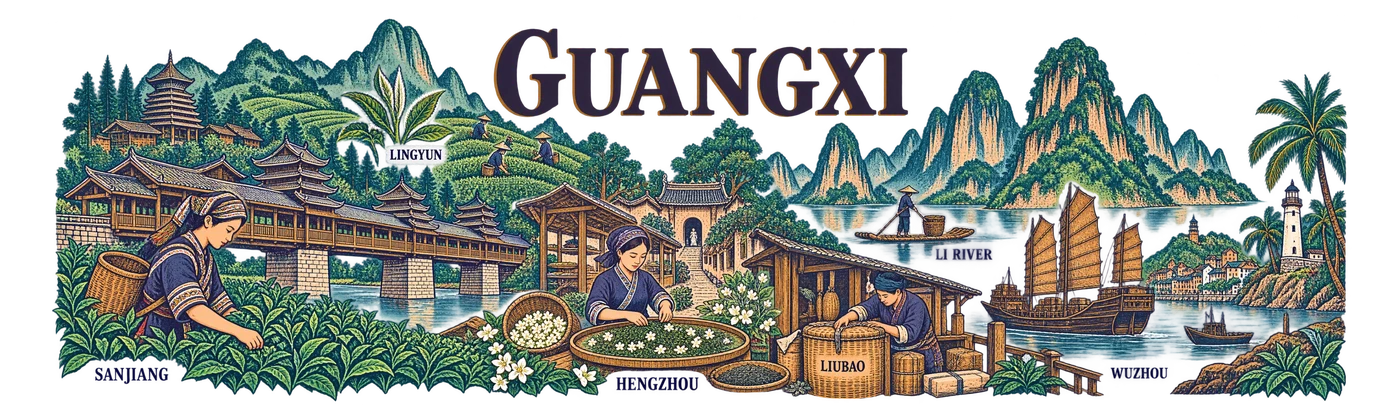
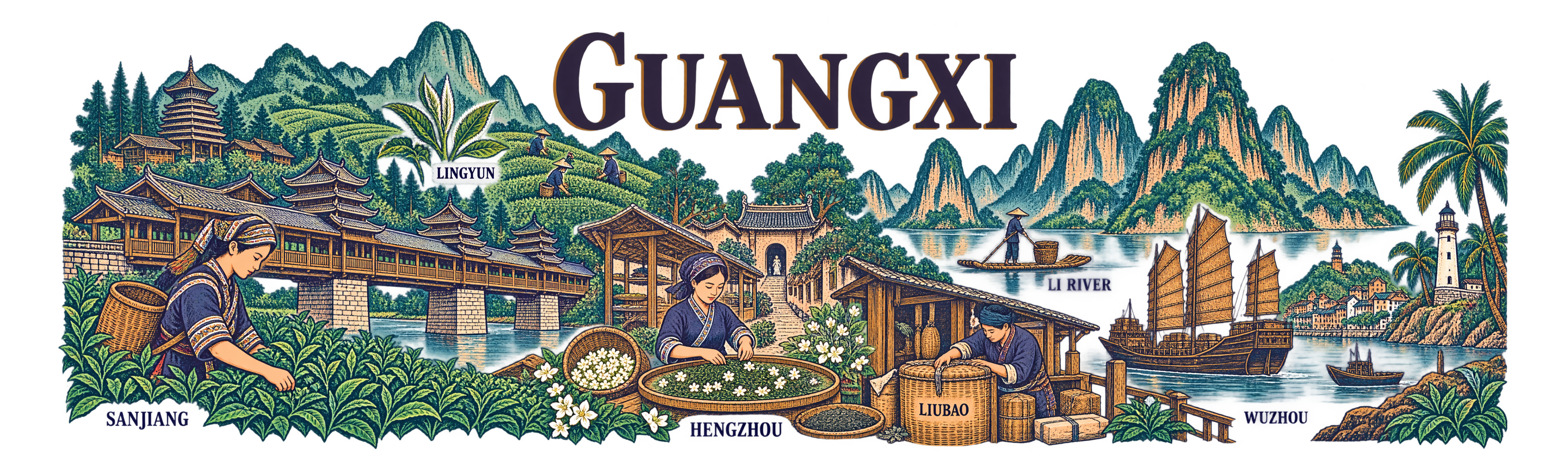
A wooden covered bridge connects the northern tea scenes with a large Wuzhou basket.
Checked for publication · Drawing review and technical check of the current file
Review basis
Full GUANGXI, clearly drawn tea crafts, bridge and river motifs. Main captions are legible, confident engraving line, large figures and the title are not cropped.
PNG RGBA 3840 × 1152 px; real alpha channel; proportional export 250 × 75 mm.
Approved after review for the open gallery; does not imply the user's endorsement of industrial production.
Creative brief palette
#423D65
#A17A28
#538A72
Original generation prompt
Text matches the public TXT. The list of inscriptions and details describes the author's brief; this is not OCR and not a promise of reproducibility without the references used.
SHA-256: 19660af51ab92b932b00cd4dcd0ecf6c894f09b6d2da9a63eeb8a4b497520152
Read the full prompt
Create an original collectible regional ceramic PRINTING DECAL, not a mug or mockup. The supplied image is a drawing/style benchmark only: replace every reference-region subject and word with the researched region described below. Make a confident, rewarding composition whose tea craft, architecture and landscape belong together.
OUTPUT: PNG RGBA, native 3840 x 1280 px. Keep every mark inside x=60..3780 and y=110..1170; use nearly the whole long strip. The final export is 3840 x 1152 px for 250 x 75 mm. Do not shrink the entire design to a central 16:9 picture. Preserve normal object proportions and complete edge objects.
ALPHA: genuine transparent exterior and natural transparent openings inside the drawing. No white or cream rectangle, paper texture, sky wash, sea fill, provincial silhouette, checkerboard, aura, gradient or drop shadow. Unpainted architecture, water and negative openings reveal alpha. Colour belongs to actual drawn objects, never a vague backdrop. Do not reproduce any opaque field visible in the reference.
For C1–C6, create ONE connected varied panorama with two or three unequal anchors, overlapping near/middle/far scales and smaller discoveries. Connect through real terrain, streets, roofs, branches and human actions, not dotted diagram routes. No two-row sticker sheet, isolated equal scenes, caption boxes, repetitive generic gardens or an empty band under the title. Do not impose a percentage of blank space. C7 instead follows its explicit irregular album direction below.
English lettering only, exact spelling, dark clear capitals for allowed captions. One main regional title. No Chinese characters, logos, invented seals, pseudo-writing, promotional superlatives or health claims. A short legible caption is preferable to microscopic text. Respect the stated distinctions between growing tea, processing it, trading it and serving it. A full research inventory need not become a printed gazetteer.

COLLECTION: AN INTIMATE HAND-DRAWN ATLAS. Follow GD01: richly observed buildings, objects, plants and lived tea culture, in three inks. Draw disciplined collector engraving with beautiful changes of scale. A curved scenic backbone links two unequal hero stories; smaller details share the terrain. An elegant serif title belongs among roofs or ridges. No independent encyclopaedia panels.
REGION: GUANGXI.
PALETTE: #423D65, #A17A28, #538A72. Preserve this regional colour family; first colour supplies the strongest contour/text. Extra dark/light rendering colours and full-colour watercolour are not wanted.
RESEARCHED CONTENT:
Preserve Guangxi's map vocabulary: northeastern rounded karst peaks and the Li River raft, northern timber covered bridge and drum-tower silhouette, Hechi tea slopes, central Daming/Dayaoshan ridges, Wuzhou river junk and Cangwu gardens, southern palm and a small coastal lighthouse/boat. Tea anchors are the Liubao bamboo storage basket, Hengzhou jasmine scenting table, Lingyun downy sprig and Sanjiang tea picker. A modest Guiping temple-side table and Jinxiu forest tea provide secondary discoveries. Longji's wet terraces, if used, are rice, not tea. River transport and Beibu coast are trade/travel stories; do not grow tea on beaches or put jasmine flowers into every regional cup. Distinguish a small bamboo raft from a large cargo junk. Unnamed map lighthouse and architecture remain generic regional motifs, without invented monument names.
AUTHORED COMPOSITION:
A northern timber covered bridge makes the long near-left backbone, with a Sanjiang picker on its approach and open water under its spans. Across the lower right, a Wuzhou storage veranda shelters a large Liubao basket and a packing hand. Behind it a cargo junk and smaller coastal palm begin the outward trade journey. Hengzhou jasmine work sits in the middle shared lane; Lingyun branch and Hechi slopes rise behind the bridge. A few northeastern karst peaks and a tiny raft provide depth without replacing tea. Three-ink collector drawing emphasises roof joints, baskets and hands; leave water, walls and leaf interiors transparent.
LETTERING PLAN:
GUANGXI once; supporting captions only LIUBAO, HENGZHOU, LINGYUN, SANJIANG, LI RIVER, WUZHOU.
REGIONAL SAFEGUARDS:
Liubao is dark tea; do not represent it only as Pu’er cakes or promise universal cave ageing. Jasmine scenting uses Camellia tea plus blossoms. Lingyun Baimao names leaf material, not an automatic white-tea category. Longji rice terraces are not tea fields. Golden camellia/oil-tea plants and medicinal infusions are not substitutes. No health claims, false ages or generic ethnic costume.
FINAL STANDARD: sharply drawn object edges, deliberate line hierarchy, vivid meaningful local differences and a recognisable whole place. Protect the main title and key silhouettes; never solve complexity by making everything equally tiny.