西藏 / XZ_C6
西藏 — 旅行线条
从采茶人的竹篓到城市茶桌和搅拌器的路径;制茶工序决定方向。
已审核可发布 · 已查看图画并对当前文件进行技术检查
250 × 75 毫米 · 3840 × 1152 像素 · RGBA · 390.144 / 390.144 ppi
审核依据
大而清晰的 TIBET 与三组清晰利落的场景:湿润的东南部茶叶处理、城市共享茶饮,以及高原 churning/yak 运输。细节保持刻意而非模糊;田野与雪域高原在视觉上分离,所有重要剪影都适合条幅。
PNG RGBA 3840 × 1152 像素;真实 alpha 通道;按比例导出 250 × 75 毫米。
经审阅后允许用于开放画廊;并不意味着用户认可工业化批量生产。
创作方案配色
#24477D
#D6A135
#A34B43
原始生成提示词
文本与公开 TXT 一致。铭文与细节清单描述的是作者任务;并非 OCR,也不承诺在缺少所用参考的情况下可复现。
SHA-256: 2557634be42b6353b90b07d9fef8461384f8dea0a019e7d6288e97c3383a5219
阅读完整提示
Create one original collector-quality flat ceramic-wrap illustration for TIBET. Native PNG RGBA, 3840 x 1280 pixels; final use 250 x 75 mm at 3840 x 1152 pixels. Keep the complete artwork inside x=100..3740 and y=130..1150. Real zero-alpha background and open internal gaps. No product photograph or mockup, paper, white backing, coloured panel, sky wash, photographic shading, watercolour fog, soft blur or grain. Borrow only the supplied reference's drawing quality, never its geography or text. Draw sharply resolved ink contours with simple deliberate flat fills. Faces, hands, roofs and leaf forms are clean and legible. Use exactly Himalayan blue #24477D, saffron #D6A135 and brick red #A34B43. No extra ink colours. The only visible word is TIBET, perfectly spelled once, large and immediately readable. No small captions, Chinese signs, Tibetan script, numbers, logos, signature or fake calligraphy.

C6 — A forceful, sharply printed journey in motion. Draw angular energetic ink contours, confident three-colour silhouettes and a shallow rising S rhythm. The large word TIBET appears in bold slightly slanted brush-cut capitals across an open upper-centre gap. Its letters must be complete and unobscured; do not omit the title or replace it with a roofline. No other writing.

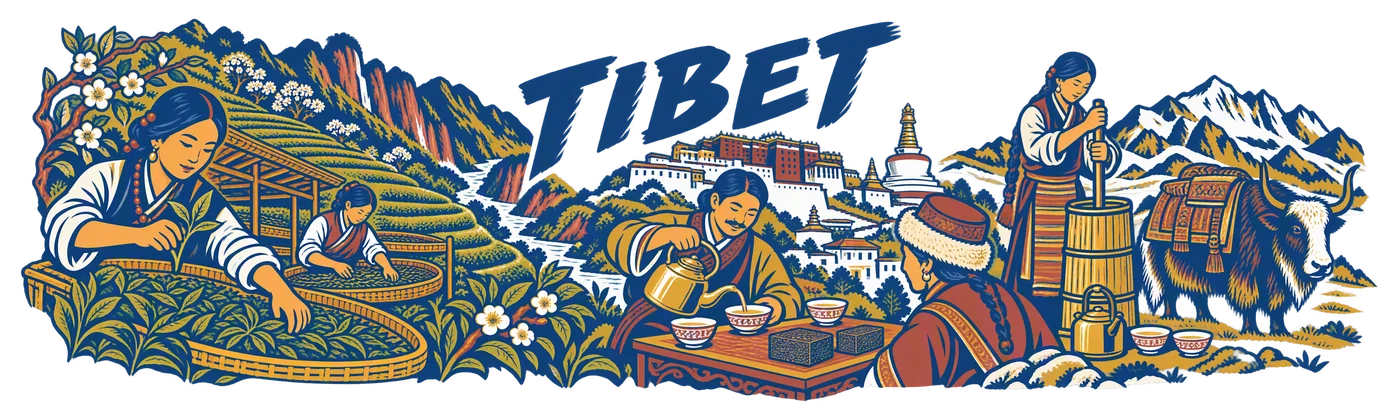
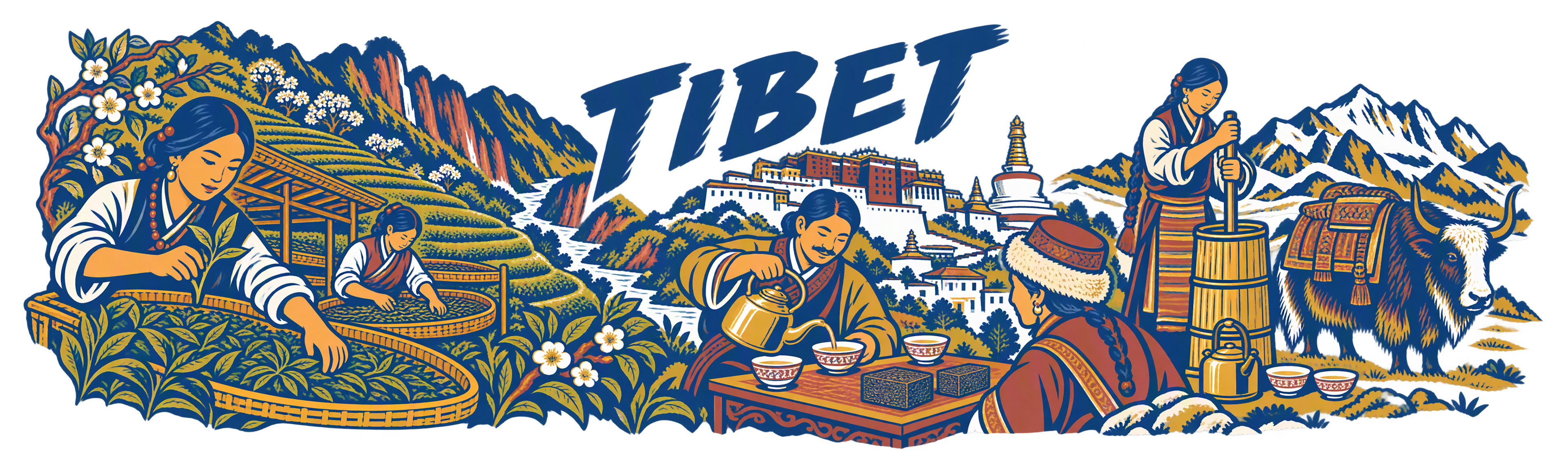
Build THREE strong visual masses with a few carefully chosen local discoveries. The largest foreground mass at the left is a southeastern tea picker extending one arm with a single tea shoot above a broad tilted bamboo basket. Another pair of clear hands rolls a handful of leaves on a large shallow tray. A modest tea shelter and three spare terrace curves rise behind them, representing the humid Yigong/Bomi, Medog and Zayu cultivation and processing world. Show real Camellia leaves, not a thousand tiny decorative specks. A peach branch and two angular Nyingchi gorge contours complete this group.

The middle mass is a lower Lhasa teahouse table seen obliquely: one host pours sweet tea from a stout metal kettle into a guest's bowl. The table's edge and pouring gesture continue the directional sweep. Two small stepped Potala roof levels and one compact Gyantse stupa rise behind this scene as cultural accents; they are not tea factories. Keep the architecture clean and countable, not a miniature city.

The right mass climbs upward through a tall wooden butter-tea churn beside a pastoral host, then a complete loaded yak and a quiet angular dry-plateau ridge. A small kettle, two bowls and two plain compressed tea bricks make the hospitality concrete. The host's face, hands and the yak's legs are distinctly drawn. Do not merge faces into the landscape.

Use blue for the main contour and title, saffron for selected vessel and garment planes, brick red for small architectural and textile accents. Clean transparent gaps separate gestures, branches and roofs while the sweeping rhythm keeps the scene cohesive. Empty snow and water are alpha openings, not white fill. Do not turn the entire plateau into a tea plantation or combine all mountains into an impossible crowded skyline. Print-quality sharpness throughout: no fuzzy foliage, muddy brushwork, halo, depth-of-field blur, clipped subjects or atmospheric background.