上海 / SH_C7
上海 — 大都市的茶生活
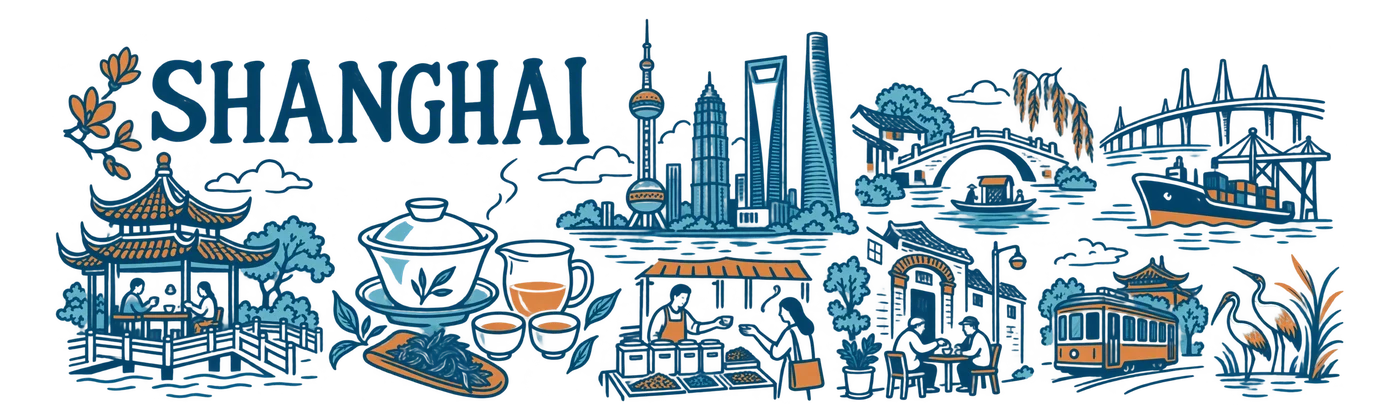
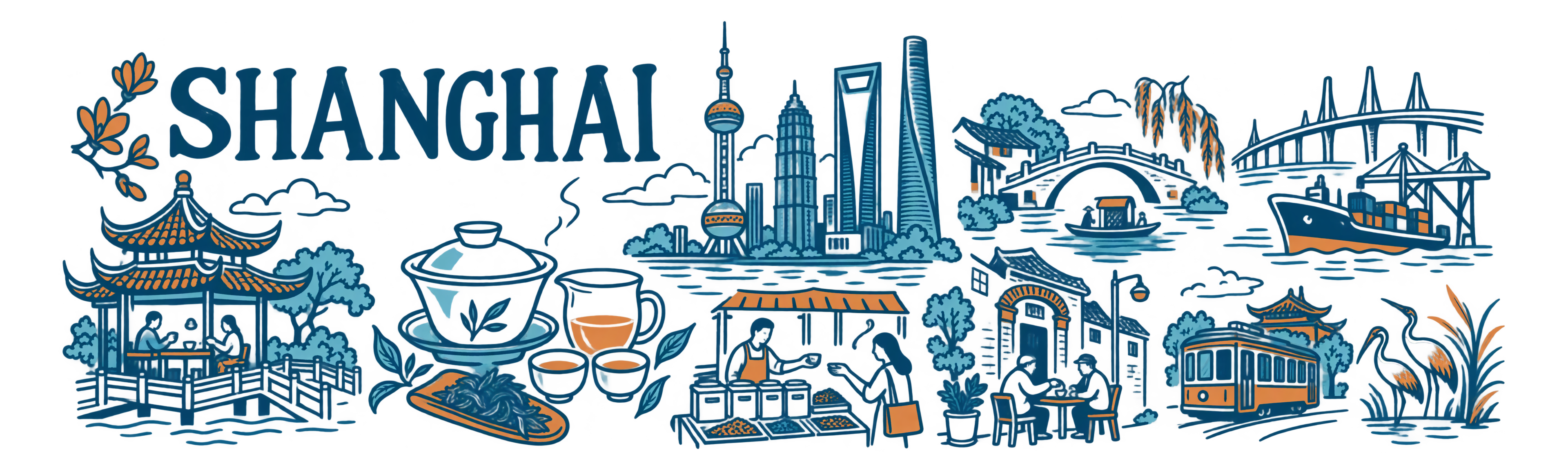
茶馆、市场和出口港之城:上海特色剪影,蓝橙手绘风格。
已审核可发布 · C7:重新查看图稿并进行技术检查
事实依据与题材选择
上海——茶叶贸易与社交之城。新任务的五个茶组分别关注湖心亭、茶叶市场、出口码头、石库门沙龙和实物品鉴。另外五个展示城市与自然。不添加茶园。
市场场景参考 Tianshan 和 Daning,但不声称精确还原立面。石库门中的茶聚是概括性的城市生活。历史码头和轮船取自地图;不声称具体船只或航次。
浦东、朱家角、带有静安图案的有轨电车、Donghai/Yangshan 和带有鸟类的芦苇 Chongming/Dongtan 形成尺度与主题的对比。荷风轩和龙华已从精简版中排除。佘山的梯田状条带不被视为茶树种植。
图名与图语
任务中只规定了一个词——SHANGHAI,用大号衬线拉丁字母。小地名、中文文本、数字和第三方标志均被排除。这是任务描述;实际可读性另行评估。
原始构思的情节清单
以下逐字列出英文作者提示中计划的组别。这是对选题的透明解释,而非承诺生成器复现了每个细节。
1。湖心亭茶馆:可辨识的中国亭子,有两层上翘的瓦顶,底层开放茶桌,两个简单的人物分享小杯;旁边有短曲桥。轮廓清晰宜人,没有巨大的寺庙或中世纪城堡。
2。放大的品茶静物:带盖的盖碗、公道杯、两只小杯和竹勺盛着长条扭曲的散茶。清晰的宽大器皿曲线。少量橙色茶汤点缀;透明的器皿主体。
3。一个茶叶市场摊位:朴素的柜台,四个无标签的储茶罐、茶则、敞开的茶叶盘,摊主将一小杯品鉴茶递给顾客。手和杯子可见,没有复杂的室内环境。
4。石库门弄堂茶景:石框住宅门口,一张小圆桌和两位坐着的邻居,其中一人正在倒茶。几面简单的墙壁和屋顶边缘,不是宫殿。
5。历史茶叶出口码头:两个敞开的木箱盛着干茶叶,一名工人和一艘小型单烟囱货轮。后面是一段外滩钟楼立面。箱子和船上没有文字。这是上海的贸易遗产,不是茶园。
6。独特的现代浦东地标群,最高的一组,但仍完全在画布内:东方明珠的大圆球和上方较小球体位于细长结构上;阶梯状金茂大厦;上海环球金融中心顶部有标志性矩形开口;弯曲收窄的上海中心大厦。四个不同、简洁可辨的轮廓,窗户稀疏,无幻想塔楼,无横跨条带的巨幅全景。
7。朱家角:一座拱形石桥、一叶小舟、两片瓦顶、两枝短柳和仅有的两条水纹。桥洞和周围水面透明。
8。历史上的上海单层有轨电车,短而圆润,几扇窗户和两个可见车轮,后面有一个小小的偏移的静安寺屋顶。空白电车标识,无香港双层车。
9。现代港口:一段带桥墩的东海大桥短弯段、一台集装箱起重机和船首。没有拉成整幅边框的桥。所有形状都舒适地容纳在内。
10。崇明湿地:两只长腿水鸟和同一blue/orange调色板中松散的一丛芦苇,三笔短岸线。无填充岛屿或水面背景。
绘制方法与风格参考
研究了广州、澳门、香港和珠海城市主题的真实旅行杯照片。从中提取了观察到的图案特征:中等生动的手绘轮廓、简单可识别的剪影、选择性平面色彩点缀和顶部带状大标题。具体查看的角度组合因地区而异。
当地场景在尺度、形态和高度上各不相同。它们的并置形成整体节奏;不设定连续全景、统一地平线、相同模块网格或固定留白比例。轮廓之间与内部保持通透。
陶瓷表面、高光、手和照片中的物体背景不属于新绘图。参考图像和个人原始照片不在此发布。每个地区的三种颜色是作者调色板,而非所拍摄茶杯的实测涂料标准。
审核依据
重新审阅根目录并对台湾第二版进行独立评审:完整的上海,四座可识别的浦东塔楼,茶具和城市茶场景;之前的裁剪和绘画式薄雾已去除。
PNG RGBA 3840 × 1152 像素;真实alpha通道;按比例导出为250 × 75 毫米。
已审核作为额外 C7 试点展示;不代表用户声称印量。轮廓比真实手绘笔触略均匀;未识别出单独的历史茶码头,不声称执行 10/10 情节。
创作方案配色
#214D69
#96C6D0
#DD9151
原始生成提示词
文本与公开 TXT 一致。铭文与细节清单描述的是作者任务;并非 OCR,也不承诺在缺少所用参考的情况下可复现。
SHA-256: e89ad1652c6b1853c7e15576ffd16758ef15b71599e19035ad518129a8b3ba8e
阅读完整提示
Draw a NEW SHANGHAI tea-and-travel illustration, matching the supplied real tourist-cup photos very closely in graphic style. Deliver ONLY flat print artwork on genuine transparent RGBA. Never depict a mug, photograph, ceramic, perspective cylinder, hands holding a product or a mockup. Learn the simple, friendly hand-drawn medium outline and sparse flat colour of the cup illustrations. Do not imitate any photographed logo, copy any monument from another city, or reproduce the curved crop of a cup photograph.

COMPLETE UNCROPPED STRIP. Native image 3840 x 1280 pixels. Fit the ENTIRE composition within x=60..3780 and y=110..1170. All marks including text, roof peaks, leaves, ship, vessel bases and tower antennas must be inside that rectangle with transparent margins on every side. Design the overall artwork as one long, low strip for a 250 x 75 mm print. Nothing may touch the canvas boundary. This is a complete finished panorama of separate little objects, never a zoomed-in fragment. No border or measurement marks.

Only visible text: SHANGHAI, spelled correctly once. Large charming uppercase souvenir serif letters in dark petrol blue, upper middle-left, occupying about one quarter of the width. Leave space above every letter. No captions, numbers, Chinese, shop signs or any other text. Letters are readable simple letters, not buildings.

Use just THREE inks: dark petrol blue #214D69 for the main drawing; soft sky blue #96C6D0 and muted orange #DD9151 for occasional flat interior patches. No black, green, white, beige, grey or additional colours. Most object interiors stay unpainted and genuinely transparent. Pen contours approximately 5 to 7 pixels thick at native size, a little uneven as drawn by a person. Simple windows, a few leaf veins, only a few hatching strokes. Crisp flat ink rather than scratchy dry brush, pencil grain, detailed engraving, watercolor, photorealism, isometric 3D or generic vector icons. Match the actual souvenir-cup drawing's immediate clear silhouettes.

Arrange TEN unequal groups in a lively interlocking rhythm, staggered heights, some larger and some smaller, like the original cups. Open irregular channels separate the groups; not a uniform icon grid and not a continuous coloured landscape. Tea activity occupies five substantial groups:
1. Huxinting teahouse: recognizable Chinese pavilion with TWO stacked upturned tiled roofs, open ground-floor tea table and two simple people sharing small cups; short zigzag bridge beside it. A welcoming clear silhouette, no immense temple or medieval castle.
2. An enlarged tea-tasting still life: lidded gaiwan, fairness pitcher, two tiny cups and bamboo scoop of long twisted loose leaves. Clear broad vessel curves. Tiny orange infusion accents; open transparent vessel bodies.
3. A tea-market stall: a plain counter with four unlabelled storage tins, scoop, open tray of leaves, and a vendor handing a little tasting cup to a customer. Hands and cup visible, no elaborate room.
4. A shikumen lane tea scene: stone-framed residential doorway with a small round table and two seated neighbours, one pouring tea. A few simple walls and roof edges, not a palace.
5. Historical tea-export dock: two open wooden chests holding dry leaves, one worker and a small ONE-funnel cargo steamer. A short Bund clock-tower facade behind them. No lettering on boxes or ship. This is Shanghai's trade heritage, not a tea plantation.
Balance them with FIVE compact city and nature groups:
6. Distinctive modern Pudong landmark cluster, the tallest group but still fully inside the canvas: Oriental Pearl's large round sphere and smaller upper sphere on a narrow structure; stepped Jin Mao; Shanghai World Financial Center with its recognizable rectangular opening at the top; curved tapering Shanghai Tower. Four different, simple recognizable outlines, sparse windows, no fantasy towers and no giant panorama spanning the strip.
7. Zhujiajiao: one arched stone bridge, small skiff, two tiled roofs, two short willow branches and only two water lines. Bridge openings and surrounding water transparent.
8. Historical Shanghai SINGLE-deck tram, short and rounded, a few windows and two visible wheels, with a small offset Jing'an temple roof behind it. Blank tram signage, no Hong Kong double-decker.
9. Modern harbour: short curved Donghai Bridge segment with piers, one container crane and ship bow. No bridge stretched into a full-width border. All shapes comfortably contained.
10. Chongming wetland: two long-legged waterbirds and a loose cluster of reeds in the same blue/orange palette, three short bank strokes. No filled island or water background.

Make the headline, round gaiwan, pavilion and Pudong silhouettes the anchors; fit smaller scenes between their irregular edges. Vary scale generously. The title and vessels must be easily seen at printed 250 mm width. Do not crowd architecture with hundreds of windows, do not invent western towers, no huge botanical leaf, no repeated anonymous cups or filler clouds. Tea grows elsewhere and is traded/enjoyed here: no tea plantation in Shanghai. Only the specified local urban and wetland subjects.

Crucial transparency: every area without an actual coloured pen mark or deliberately small accent fill is alpha zero. No white rectangle, white stickers behind objects, paper, cream wash, background painting, checkerboard simulation, glow or drop shadow. No opaque interior fill by default. The white visible in reference photographs is ceramic and MUST become transparency in this new flat file. Produce one clear, complete, uncropped, inviting drawing in the real cups' visual language.