贵州 / GZ_C5
贵州——塔、瀑布与茶盘
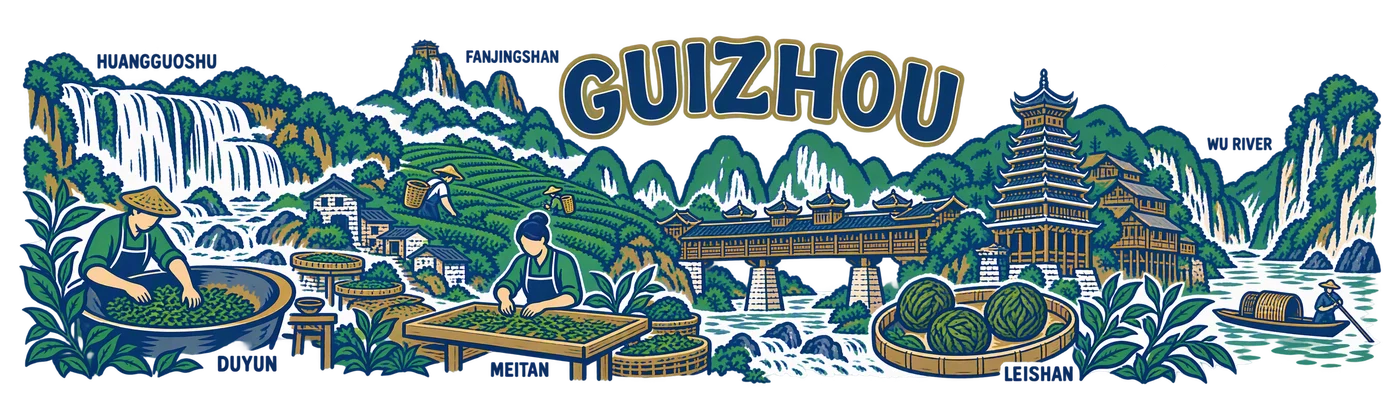
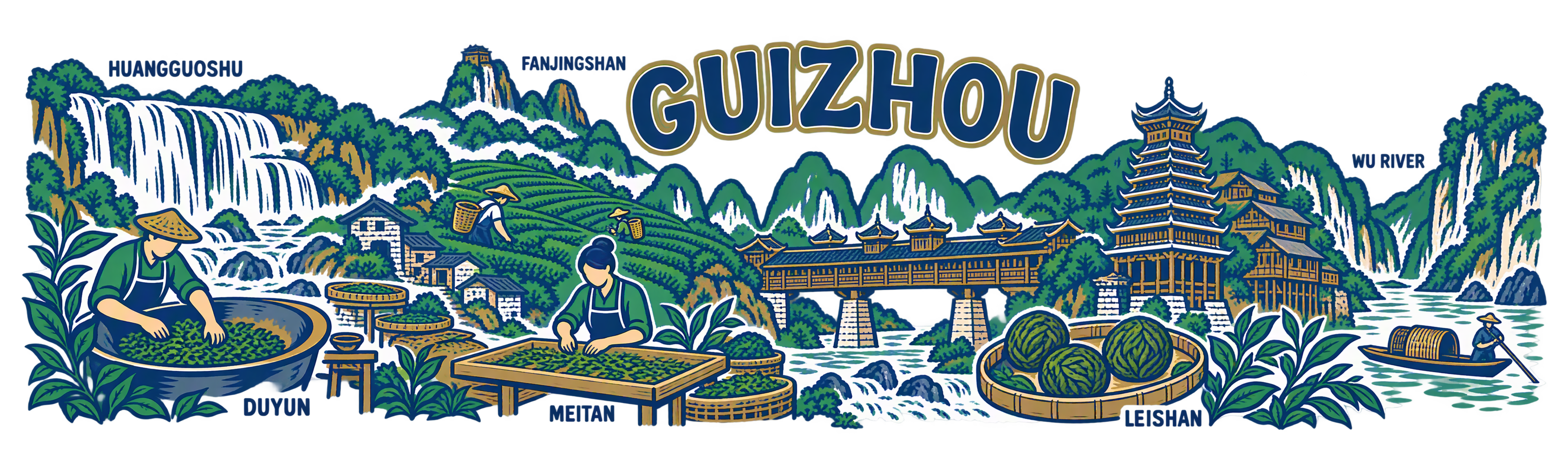
大型剪影的图形化展示,茶形清晰可辨。
已审核可发布 · 已查看图画并对当前文件进行技术检查
250 × 75 毫米 · 3840 × 1152 像素 · RGBA · 390.144 / 390.144 ppi
审核依据
清晰的GUIZHOU双字,干净粗轮廓与平涂色块。茶事与地域母题清晰可读,大标题无损坏;构图连贯。
PNG RGBA 3840 × 1152 像素;真实 alpha 通道;按比例导出 250 × 75 毫米。
经审阅后允许用于开放画廊;并不意味着用户认可工业化批量生产。
创作方案配色
#243F72
#56866D
#A6935B
原始生成提示词
文本与公开 TXT 一致。铭文与细节清单描述的是作者任务;并非 OCR,也不承诺在缺少所用参考的情况下可复现。
SHA-256: 7e0c36e4e1b71cdcef597bc64f108e2dee9c70d221319ae9f25d76eaabf30535
阅读完整提示
PRODUCTION CALIBRATION: use the supplied crisp print illustration as the leading standard for edge clarity, and use any cup photo only for its hand-drawn spirit. Create original local subjects; never reproduce the reference title or region. All strokes and letters must be sharp, complete, readable and deliberately drawn. No painterly blur, soft dirty halos, translucent smearing, duplicated words or pseudo-writing. Every complete object and letter stays 120 pixels inside each native edge. All unpainted exterior and interior openings must be genuine transparent alpha, not an opaque white canvas. Replace any weak fine detail with fewer clear graphic marks.

Create an original collectible regional ceramic PRINTING DECAL, not a mug or mockup. The supplied image is a drawing/style benchmark only: replace every reference-region subject and word with the researched region described below. Make a confident, rewarding composition whose tea craft, architecture and landscape belong together.
OUTPUT: PNG RGBA, native 3840 x 1280 px. Keep every mark inside x=60..3780 and y=110..1170; use nearly the whole long strip. The final export is 3840 x 1152 px for 250 x 75 mm. Do not shrink the entire design to a central 16:9 picture. Preserve normal object proportions and complete edge objects.
ALPHA: genuine transparent exterior and natural transparent openings inside the drawing. No white or cream rectangle, paper texture, sky wash, sea fill, provincial silhouette, checkerboard, aura, gradient or drop shadow. Unpainted architecture, water and negative openings reveal alpha. Colour belongs to actual drawn objects, never a vague backdrop. Do not reproduce any opaque field visible in the reference.
For C1–C6, create ONE connected varied panorama with two or three unequal anchors, overlapping near/middle/far scales and smaller discoveries. Connect through real terrain, streets, roofs, branches and human actions, not dotted diagram routes. No two-row sticker sheet, isolated equal scenes, caption boxes, repetitive generic gardens or an empty band under the title. Do not impose a percentage of blank space. C7 instead follows its explicit irregular album direction below.
English lettering only, exact spelling, dark clear capitals for allowed captions. One main regional title. No Chinese characters, logos, invented seals, pseudo-writing, promotional superlatives or health claims. A short legible caption is preferable to microscopic text. Respect the stated distinctions between growing tea, processing it, trading it and serving it. A full research inventory need not become a printed gazetteer.

COLLECTION: A BOLD REGIONAL PARADE. Follow GD02: confident friendly pen contours, spare flat three-colour accents and large double-contour regional lettering. Build a lively procession of unequal silhouettes, tea activity, architecture and vessels. Let actual terrain and roof rhythms connect the drawings. This should be immediate and memorable, with clear positive and negative shapes, not intricate engraving.
REGION: GUIZHOU.
PALETTE: #243F72, #56866D, #A6935B. Preserve this regional colour family; first colour supplies the strongest contour/text. Extra dark/light rendering colours and full-colour watercolour are not wanted.
RESEARCHED CONTENT:
The source map combines rounded karst hills, Meitan and Duyun tea slopes, a narrow Wu River gorge with a small boat, the broad falling curtain of Huangguoshu, Anshun stone houses, and southeast wooden stilt houses, a drum tower and covered bridge. Use the covered bridge and timber roofs as specific southeast travel motifs, not universal architecture across every county. Tea stays in the foreground: Duyun curling hand, Meitan flat-leaf board, Leishan tea-ball tray, Shiqian branch, and one small Zunyi/Pu'an black-tea workbench. Guiding and Fanjingshan gardens can nest into farther slopes. Keep the waterfall an open line-and-edge subject, never an opaque white rectangle. Do not invent a named village or architectural identity beyond what the map supports; do not draw costume pageantry in place of tea production.
AUTHORED COMPOSITION:
Alternate a low broad Duyun tea pan, a tall but simple drum tower, a Meitan sorting board and a rounded karst pair across the strip. A covered bridge links the lower silhouettes; Huangguoshu is a wide line curtain behind the left, while a small gorge boat terminates the right. Leishan tea balls are three large readable shapes in a real tray, not a dot pattern scattered everywhere. Double-outline GUIZHOU sits among the changing roof heights. Keep tea work and tools larger than distant tourist landmarks. Bold friendly contours and three flat inks create collectible immediacy; avoid dense carving, tiny costumes and a solid green landscape.
LETTERING PLAN:
GUIZHOU once; supporting captions only DUYUN, MEITAN, LEISHAN, FANJINGSHAN, HUANGGUOSHU, WU RIVER.
REGIONAL SAFEGUARDS:
Zheng’an Baicha is not automatically white-tea processing. Leishan tea balls are leaves, not silver pearls. Separate black-tea rolling from green-tea shaping. No zinc/selenium health claims or mythical ancient-tree ages. Southeastern drum towers and covered bridges are not universal Guizhou architecture. The print is an editorial journey, not a precise surveyed geographic map.
FINAL STANDARD: sharply drawn object edges, deliberate line hierarchy, vivid meaningful local differences and a recognisable whole place. Protect the main title and key silhouettes; never solve complexity by making everything equally tiny.