广东 / GD01
茶园
有机细腻的拼贴:两座茶谷、植物与城市场景交织于绿粉色调的画面中。
已审核可发布 · 用户选定具体图画作为视觉基准
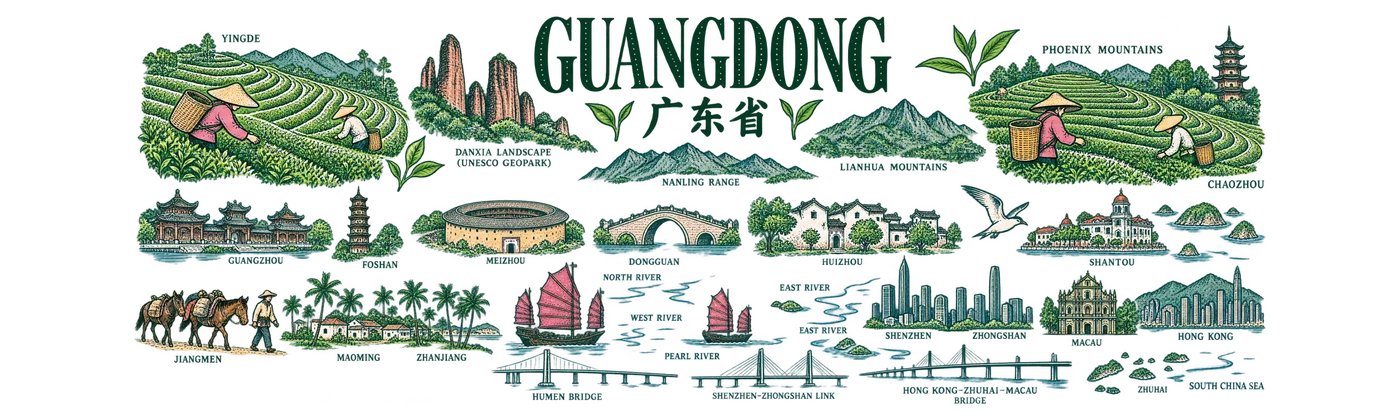
250 × 75 毫米 · 3840 × 1152 像素 · RGBA · 390.144 / 390.144 ppi
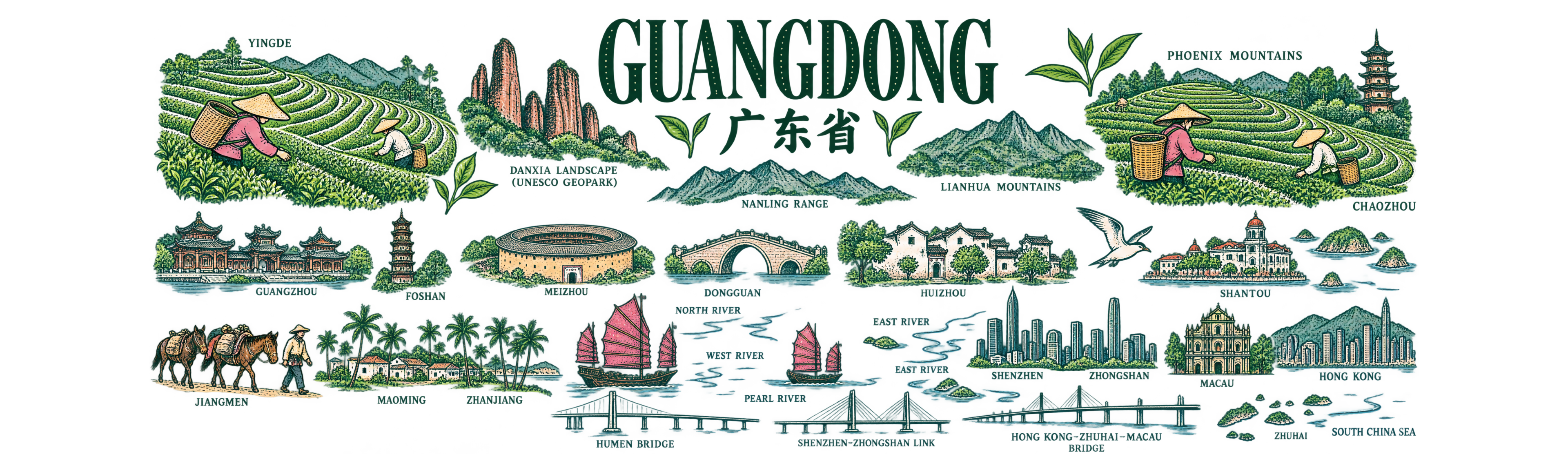
审核依据
用户选择的六件广东作品确定 C1–C6:GD24、GD22、GD18、GD01、GD02、GD03。
reference_origin 将每个选定方向与特定的最终作品或 masters/final. 关联
master_file/artwork_file 规范地将选定的最终大师与已发布的 PNG 联系起来。
正面用户评价针对的是被选为基准的那张特定最终图像。这是视觉选择的证据,而非逐字符的完整 QA;批量技术检查不能替代这一区别。
创作方案配色
#164C3D
#85A94D
#C98CA4
原始生成提示词
文本与公开 TXT 一致。铭文与细节清单描述的是作者任务;并非 OCR,也不承诺在缺少所用参考的情况下可复现。
SHA-256: 0823a000c99c357a2549ee95a2f75fa5ed0fb2afe225d62543e742159a2fbc8a
阅读完整提示
Create ONE flat, exceptionally wide travel-souvenir decal illustration for GUANGDONG. The artwork consists of many SEPARATE hand-drawn little scenes on genuine transparency, like the illustrated motifs printed directly onto an unprinted ceramic cup. Only crisp coloured pen lines, short hatching and small bounded spot-colour accents are present. This is a new arrangement of isolated objects, NOT a geographical map, NOT a recoloured map, NOT an island-shaped landmass. Never connect the scenes with a filled area. Every vignette ends at a crisp ink edge. Transparent space must flow between and THROUGH the drawings.

Create a wonderfully rich but porous 10:3 panoramic collection in two or three irregular shallow rows. Around 18–24 recognizable little scenes, alternating large and small, fit together without touching their opaque silhouettes. Make the two tea-harvest scenes the largest. At least55 percent of the whole composition should be genuinely clear. Interiors of outlined buildings, skies, water and letter counters are transparent. The only filled colours belong to small parts of individual objects. No white or cream backing, no coloured land, no sea fill, no cloud of translucent colour, no glow, no fuzzy colour halo, no wash, no shadow, no paper texture, no gradient, no large solid panel, no rectangle, no sticker backing. Flat sharp ink, never a painted atmosphere.

DRAW ALL THESE SUBJECTS, distributed as detached vignettes rather than arranged within a map outline: (1) Yingde curving tea terraces with two broad-hatted harvesters and baskets; (2) Phoenix Mountains/Chaozhou tea terraces with two harvesters and their pagoda; (3) two separate tea-leaf emblems; (4) Nanling ridge fragments; (5) Lianhua ridge fragments; (6) upright Danxia rock columns; (7) Guangzhou traditional roofed buildings and a separate pagoda; (8) a little stone arch bridge; (9) a round walled courtyard dwelling; (10) horse/mule pack caravan and handlers; (11) southwest village with palm trees; (12) additional palm grove; (13) TWO Chinese sailing junks, separate and different sizes; (14) one flying seabird; (15) Humen Bridge; (16) Shenzhen–Zhongshan Link; (17) Hong Kong–Zhuhai–Macau Bridge; (18) a few thin, branching river lines, tiny coastline curves and little islands. Tea rows use clear contour lines and occasional green strips, NOT filled hillsides. Draw the water with just a few open ripple strokes. No foods, tea ware, named tea cultivars, fireworks, mascots, modern unrelated skyscrapers or borrowed commercial logos.

The main title reads exactly "GUANGDONG", with smaller "广东省". Distribute these exact short place names as captions beside the individual scenes, with enough clear space around each: YINGDE; SHAOGUAN; MEIZHOU; CHAOZHOU; SHANTOU; GUANGZHOU; FOSHAN; DONGGUAN; HUIZHOU; JIANGMEN; ZHONGSHAN; SHENZHEN; ZHUHAI; HONG KONG; MACAU; MAOMING; ZHANJIANG. Add the landscape captions NANLING RANGE, LIANHUA MOUNTAINS, PHOENIX MOUNTAINS and DANXIA LANDSCAPE with (UNESCO GEOPARK). Use NORTH RIVER, WEST RIVER, EAST RIVER, HAN RIVER, PEARL RIVER and SOUTH CHINA SEA beside sparse water-line fragments; these are lettering and fine strokes, never coloured water patches. Caption the three distinct bridges HUMEN BRIDGE, SHENZHEN–ZHONGSHAN LINK and HONG KONG–ZHUHAI–MACAU BRIDGE; long names can wrap to two lines. These are separate regional memories, not a literal scale map or a claim about administrative borders. Use carefully drawn readable small capitals, not fake microtext or a separate name list. Keep wording accurate, once each, with no extra slogans.

STYLE01 — THE TEA GARDEN. A lively and organic collector's illustration in forest-green outline #164C3D, leaf green #85A94D and dusty rose #C98CA4. Fine but decisive slightly irregular penwork, tiny stippled leaf details, curved tea-row contours, a few woven-basket hatch marks. Large tall serif GUANGDONG letters, with tiny transparent pinholes within the dark stems, occupy an open pocket just above the centre. A large Yingde terrace vignette at the left and a large Phoenix/Chaozhou terrace vignette at the right act as visual bookends. Each is detached: no connecting ground. Between them, stagger the smaller Danxia rocks, two ridge fragments, Guangzhou buildings, the courtyard dwelling and stone arch. The lower row alternates caravan, palm village, three slender bridges and two junks, with small objects tucked above and between. Let tea-leaf sprigs and a few short river strokes create visual echoes without closing the gaps. Keep generous clear sky inside every scene. The line feels personal and observant, like a richly illustrated local travel notebook; the image is lively, highly detailed and fresh rather than antique or realistic. Do not use coloured background shading around the fine lines.

OUTPUT: native RGBA PNG with genuine transparent background. 3840×2160 carrier; place ALL drawing and lettering inside only the central 3840×1152 strip, y=504..1656, with another40px of internal edge clearance. Nothing above or below this strip. The art must spread across almost the full strip width as a single ultra-wide10:3 composition for250×75mm, never a square or a tall poster. Ink strokes and bounded coloured object accents should be substantially opaque and crisp; all negative space alpha0. No picture of a mug, no surface, no mockup, no table, no rectangular backdrop, no painted checkerboard, no full-map silhouette, no fog, no colour halo. Only the foreground pen drawing and its text.