Юньнань / YN_C4
Yunnan — От снежного хребта к чайному лесу
Три глубины: северные торговые пути, городские крыши и крупный южный чайный двор.
Проверено для публикации · Просмотр рисунка и техническая проверка текущего файла
Региональное исследование и источники
Основание проверки
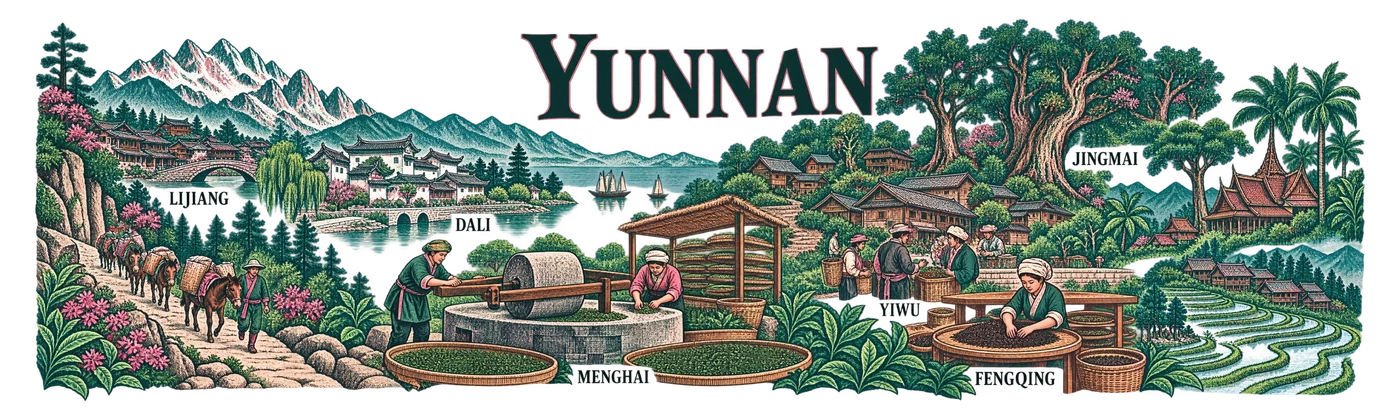
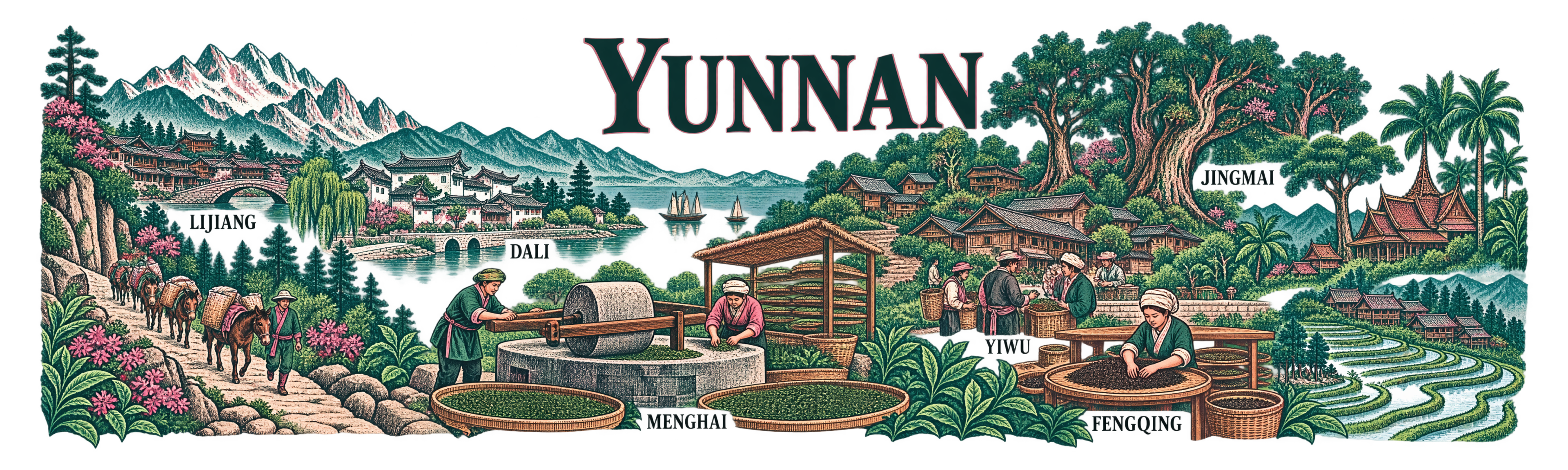
Полный YUNNAN, крупные чайные деревья и ремесленные сцены, караван и местная архитектура читаются ясно. Гравюрные детали и главные подписи чистые, без крупных обрезок и размытых ореолов.
PNG RGBA 3840 × 1152 px; настоящий альфа-канал; пропорциональный экспорт 250 × 75 мм.
Допущен после просмотра для открытой галереи; не означает утверждение пользователем промышленного тиража.
Палитра авторского задания
#174E47
#BD597E
#7AA361
Точное текстовое задание
Текст совпадает с публичным TXT. Перечень надписей и деталей описывает авторское задание; это не OCR и не обещание воспроизводимости без использованных референсов.
SHA-256: 54f90aa9426f9b7d38ef136ce2e6d6f58e3881f4b41303a7bec0ab83b02ca099
Прочитать полный промпт
Create an original collectible regional ceramic PRINTING DECAL, not a mug or mockup. The supplied image is a drawing/style benchmark only: replace every reference-region subject and word with the researched region described below. Make a confident, rewarding composition whose tea craft, architecture and landscape belong together.
OUTPUT: PNG RGBA, native 3840 x 1280 px. Keep every mark inside x=60..3780 and y=110..1170; use nearly the whole long strip. The final export is 3840 x 1152 px for 250 x 75 mm. Do not shrink the entire design to a central 16:9 picture. Preserve normal object proportions and complete edge objects.
ALPHA: genuine transparent exterior and natural transparent openings inside the drawing. No white or cream rectangle, paper texture, sky wash, sea fill, provincial silhouette, checkerboard, aura, gradient or drop shadow. Unpainted architecture, water and negative openings reveal alpha. Colour belongs to actual drawn objects, never a vague backdrop. Do not reproduce any opaque field visible in the reference.
For C1–C6, create ONE connected varied panorama with two or three unequal anchors, overlapping near/middle/far scales and smaller discoveries. Connect through real terrain, streets, roofs, branches and human actions, not dotted diagram routes. No two-row sticker sheet, isolated equal scenes, caption boxes, repetitive generic gardens or an empty band under the title. Do not impose a percentage of blank space. C7 instead follows its explicit irregular album direction below.
English lettering only, exact spelling, dark clear capitals for allowed captions. One main regional title. No Chinese characters, logos, invented seals, pseudo-writing, promotional superlatives or health claims. A short legible caption is preferable to microscopic text. Respect the stated distinctions between growing tea, processing it, trading it and serving it. A full research inventory need not become a printed gazetteer.

COLLECTION: AN INTIMATE HAND-DRAWN ATLAS. Follow GD01: richly observed buildings, objects, plants and lived tea culture, in three inks. Draw disciplined collector engraving with beautiful changes of scale. A curved scenic backbone links two unequal hero stories; smaller details share the terrain. An elegant serif title belongs among roofs or ridges. No independent encyclopaedia panels.
REGION: YUNNAN.
PALETTE: #174E47, #BD597E, #7AA361. Preserve this regional colour family; first colour supplies the strongest contour/text. Extra dark/light rendering colours and full-colour watercolour are not wanted.
RESEARCHED CONTENT:
Yunnan shifts from snowy northwest to lush tea-bearing southwest. Preserve Jade Dragon peaks, the Jinsha/parallel-gorge idea, Lijiang timber roofs, Dali Bai-style architecture by Erhai, western Gaoligong terrain, a small old tea caravan, southern Dai roof and palm silhouettes, and eastern Hani wet-rice terraces. Rice terraces are not tea rows. The tea anchors are Jingmai forest tea beneath taller trees, Menghai stone pressing and sun-drying, Yiwu trading village, Fengqing Dianhong rolling, and a small Lincang picking path. Dali and Kunming are also tea circulation and serving places; northern yak/monastery travel motifs should remain geographically distinct from tropical tea. Use only a few observed architecture types rather than generic pagodas everywhere. Water stays open alpha, with separate river strokes rather than merging three parallel rivers into one channel. No dates or invented antiquity claims.
AUTHORED COMPOSITION:
A small snowy Jade Dragon range and Lijiang wooden roofs rise in the far left background, followed by Dali eaves and the open Erhai shore. A pack-animal caravan descends a broad scenic path into the near central tea court, where a large stone press and drying mat make the commercial tea meaning clear. At right, Jingmai canopy overlaps a modest village and Dai roof/palm silhouette, with a Fengqing rolling table as a distinct lower branch of the journey. A compact Hani rice terrace motif occupies the far right lower corner with open water steps; do not label it tea. Three inks and collector engraving give depth without a painted landscape backdrop.
LETTERING PLAN:
YUNNAN once. At most six supporting captions: JINGMAI, MENGHAI, FENGQING, YIWU, DALI, LIJIANG.
REGIONAL SAFEGUARDS:
Jingmai is forest-understorey tea, not regimented clipped terraces. Fengqing Dianhong is black tea; Pu’er cakes do not replace every regional tea. Hani terraces grow rice, not tea. Snowy Shangri-La/Jade Dragon is travel context, not a tropical tea estate. Do not merge the three parallel rivers. No invented ethnic costume, giant ancient-age labels, brand wrappers or medical claims.
FINAL STANDARD: sharply drawn object edges, deliberate line hierarchy, vivid meaningful local differences and a recognisable whole place. Protect the main title and key silhouettes; never solve complexity by making everything equally tiny.