Shandong / SD_C6
Shandong — Горная тропа и морской ветер
Тропинка от чайной корзины проходит через берег и культурные вершины.
Проверено для публикации · Просмотр рисунка и техническая проверка текущего файла
Региональное исследование и источники
Основание проверки
Крупный чайный жест, сортировка и обработка сохраняют главное значение; SHANDONG читается, подписи осмысленные, линии ясные и без грязной мягкой подложки.
PNG RGBA 3840 × 1152 px; настоящий альфа-канал; пропорциональный экспорт 250 × 75 мм.
Допущен после просмотра для открытой галереи; не означает утверждение пользователем промышленного тиража.
Палитра авторского задания
#244F67
#D08836
#819853
Точное текстовое задание
Текст совпадает с публичным TXT. Перечень надписей и деталей описывает авторское задание; это не OCR и не обещание воспроизводимости без использованных референсов.
SHA-256: 91ab0d9d188cb01d0d91b0fdb3d1744b11694275b74ae31ee1fcbf13a075847c
Прочитать полный промпт
Create an exceptional original flat illustration for a collectible tea-region ceramic wrap. The attached image is a STYLE reference, not a content reference: preserve its drawing intelligence, print character and relationship between title, scenes and empty glaze; replace every Guangdong-specific subject and word. Output one panoramic native 3840 x 1280 pixel PNG with a genuine RGBA alpha channel. All artwork, including lettering, must remain wholly inside x60..3780 and y110..1170. The upper and lower outside bands and the external negative space must be transparent, not white paint. The final production crop will be 3840 x 1152 pixels for a 250 x 75 mm wrap; do not draw dimensions, crop marks or a frame. No mug, mockup, photograph, simulated paper, decorative rectangular background, cast shadow, checkerboard or watermark.

DRAWING AND PRINT DISCIPLINE: Use confident authored linework, recognisable local silhouettes, selective flat colour and well-resolved hands, vessels and architecture. Details reward close looking but the main story reads across a small ceramic surface. Colour belongs to actual drawn objects or deliberate bounded accents. Transparent sky, river openings, architectural gaps and open vessel interiors are part of the design. Do not use a continuous opaque landscape base, atmosphere wash, cream substrate or enormous filled silhouette behind everything. Keep deliberate pauses between major masses without making a sticker sheet. Never cut off a letter, roof, person, handle or tree at the image boundary. Do not scatter repeated generic teapots as filler. Each featured tea action must communicate a different part of the region's tea story. This is an illustrated interpretation, not a navigable map: no compass, coordinate grid, dotted connectors, numbered pins, legend or tiny labels.

COLLECTION C6 — JOURNEY LINES.
Three-ink energetic angular drawing with bold slanted regional lettering, directional hatching and a dynamic diagonal or shallow S-shaped journey across the width. A near tea craft or hospitality action has dramatic scale; landmarks recede behind it. Regional movement gives the line a purpose. Strong recognisable silhouettes and intersecting depth planes, not scattered stamps, comic panels, scribble chaos or generic adventure badges. Keep angular energy legible and preserve clear transparent channels.

REGION: SHANDONG. EXACT PALETTE: #244F67, #D08836, #819853. Use only these opaque graphic inks and their clean antialiased edges; no white ink, black substitution or extra colours. Transparent negative space is not an additional ink.

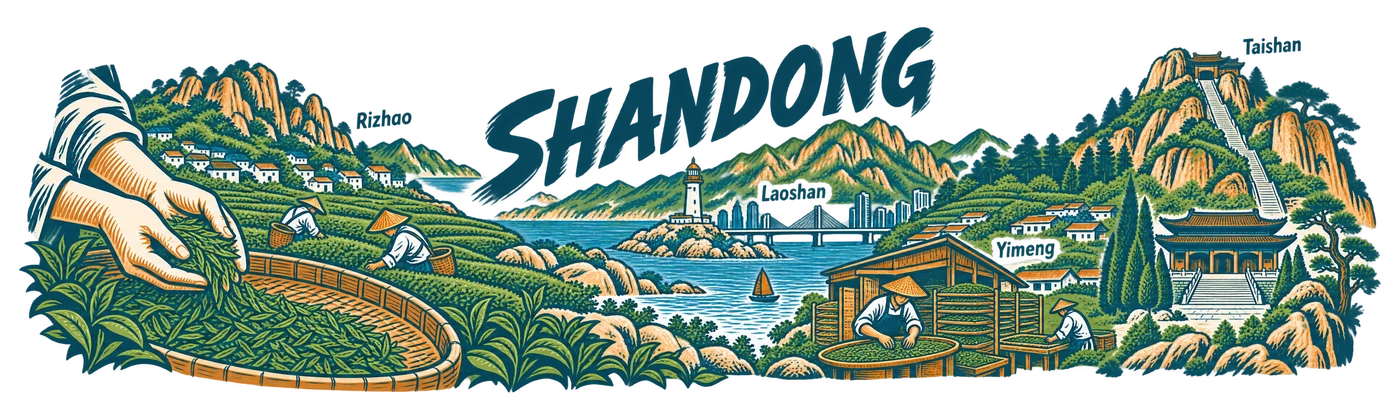
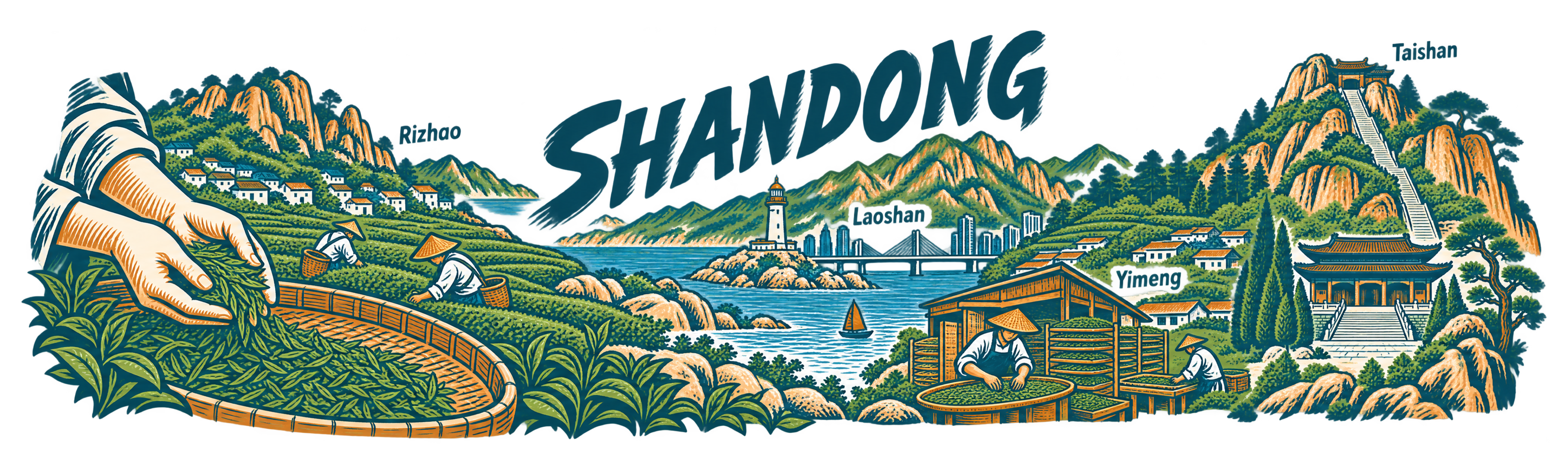
A diagonal close tea-sorting tray opens toward the viewer; full hands lift a small handful of green-tea leaves. From that near Rizhao scene, the journey bends past Laoshan rows and granite, a far Qingdao lighthouse and bay bridge, then rises toward Taishan's narrow stair. Qufu roof geometry and a small inland Yimeng tea shed are secondary discoveries at the return bend. A single tiny boat is enough to imply the Yellow Sea. Avoid oversized waves swallowing the local tea story.

REGIONAL TRUTH: Shandong's documented tea identities include Laoshan green tea around Qingdao, Rizhao green tea and the Yimeng tea area around Linyi. Wanggezhuang is a major Laoshan growing and processing locality; Rizhao has tea producers in Lanshan and Ju County. Junan, Yishui and Linshu are real parts of the Yimeng tea story. Show northern coastal cultivation in low hedges, leaf handling, processing and drinking, not tea bushes growing in seawater. Taishan and Qufu are cultural landmarks, not evidence for monastic tea estates. Do not claim that Laoshan is the only seaside tea or that all Shandong hills are planted with tea.

SPECIFIC COMPOSITION: Use an energetic S-shaped coastal path with dark coastal ink, sunrise and green accents. Slanted SHANDONG occupies the broad central pause. Directional hatching follows wicker and stone planes, never blurring hands. Every object and full letter ends comfortably before the safe boundary.

TEXT: Main title exactly "SHANDONG". Secondary labels, each once and attached to its correct scene: Rizhao; Laoshan; Yimeng; Taishan. No other text.

FINAL ART DIRECTION: Make every major group different in scale and gesture. Do not give every scene a surrounding halo or a separate base. A viewer should discover a clear regional idea at arm's length and then human actions, leaf shapes and local building features nearby. Keep the specified palette visible as actual graphic inks, not merely a tint over green scenery. Do not add unrequested slogans, stamps, logos, dates, Chinese characters or gibberish. The exact allowed English words below are the entire text vocabulary. Keep secondary words comfortably readable if allowed; omit a minor caption rather than shrinking it to microscopic lettering. Render the regional title exactly once and complete, with comfortable space around it. No extra title repeated on vessels or buildings. Draw a finished cohesive piece of print art, never a presentation board.