Пекин / BJ_C4
Beijing — Двор и небесный круг
Городская чашка соединяет скромный hutong и крупную архитектуру.
Проверено для публикации · Просмотр рисунка и техническая проверка текущего файла
Региональное исследование и источники
Основание проверки
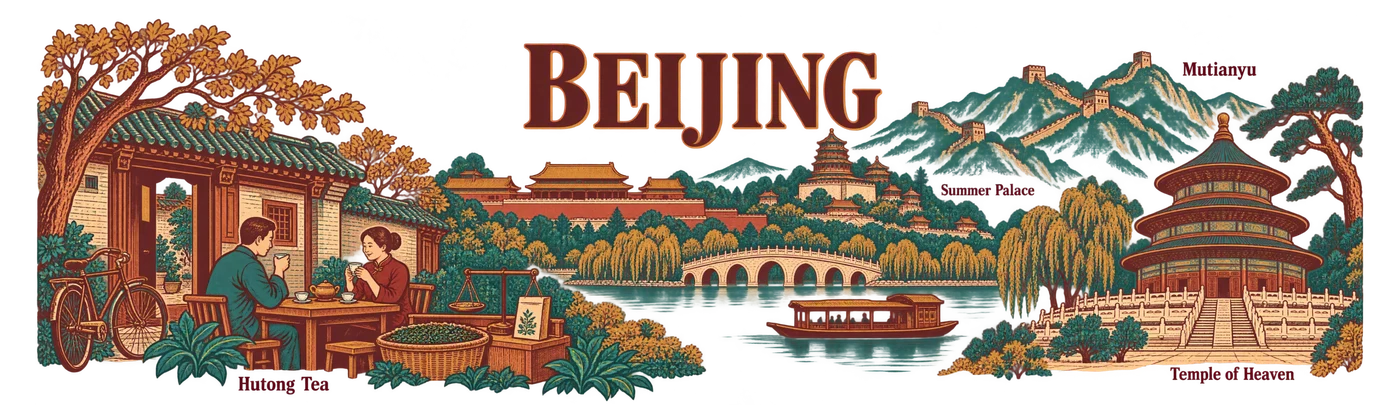
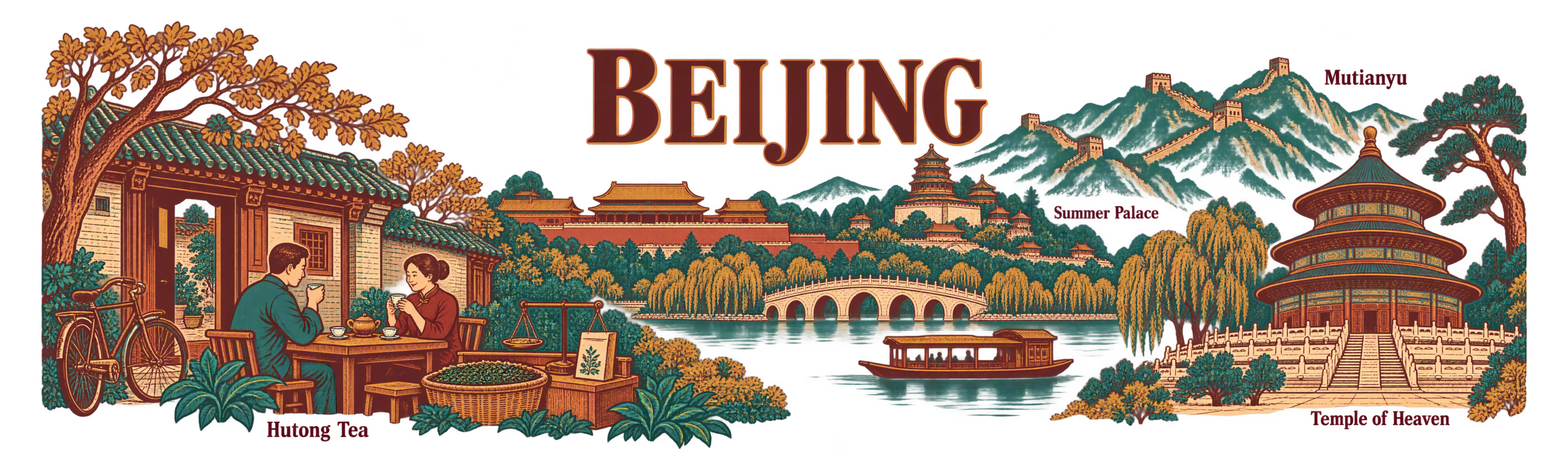
Повторная попытка: оба колеса велосипеда теперь полностью помещены, левый чайный двор завершён. BEIJING, Hutong Tea, Mutianyu, Summer Palace и Temple of Heaven читаются; рисунок ясный.
PNG RGBA 3840 × 1152 px; настоящий альфа-канал; пропорциональный экспорт 250 × 75 мм.
Допущен после просмотра для открытой галереи; не означает утверждение пользователем промышленного тиража.
Палитра авторского задания
#702A2D
#C58B36
#587D79
Точное текстовое задание
Текст совпадает с публичным TXT. Перечень надписей и деталей описывает авторское задание; это не OCR и не обещание воспроизводимости без использованных референсов.
SHA-256: 17577bc80ce301faebcc972e93fa66fc086626a0861cb561a3818f68bc25bd54
Прочитать полный промпт
RENDERING REQUIREMENTS: Produce a new, completely crisp region-specific illustration. Borrow ONLY drawing style from the references; do not copy their region, title or place names. Use the exact region and English lettering in the brief. No blurred patches, mist, smoky shading, translucent brush smears or soft-focus architectural details. No clipping of objects or letters: keep an 80-pixel clear safety margin around the complete composition. True PNG RGBA transparency between the drawn shapes; no opaque white or coloured backing. Sharp ink edges, legible deliberate lettering.

PRINT CALIBRATION — Create a completely NEW region-specific illustration, borrowing ONLY the line quality and composition intelligence from the reference. Do not copy the reference region, its title or its place names. Draw the region named below. Absolutely sharp, clean edges; no blur, smudging, cloudy shading or atmospheric washes. All letterforms exact. Keep every major object, title and letter entirely inside the canvas with a clear 80-pixel safety margin; no straight vertical cutoffs at the sides. RGBA with truly empty alpha between objects.

Create an exceptional original flat illustration for a collectible tea-region ceramic wrap. The attached image is a STYLE reference, not a content reference: preserve its drawing intelligence, print character and relationship between title, scenes and empty glaze; replace every Guangdong-specific subject and word. Output one panoramic native 3840 x 1280 pixel PNG with a genuine RGBA alpha channel. All artwork, including lettering, must remain wholly inside x60..3780 and y110..1170. The upper and lower outside bands and the external negative space must be transparent, not white paint. The final production crop will be 3840 x 1152 pixels for a 250 x 75 mm wrap; do not draw dimensions, crop marks or a frame. No mug, mockup, photograph, simulated paper, decorative rectangular background, cast shadow, checkerboard or watermark.

DRAWING AND PRINT DISCIPLINE: Use confident authored linework, recognisable local silhouettes, selective flat colour and well-resolved hands, vessels and architecture. Details reward close looking but the main story reads across a small ceramic surface. Colour belongs to actual drawn objects or deliberate bounded accents. Transparent sky, river openings, architectural gaps and open vessel interiors are part of the design. Do not use a continuous opaque landscape base, atmosphere wash, cream substrate or enormous filled silhouette behind everything. Keep deliberate pauses between major masses without making a sticker sheet. Never cut off a letter, roof, person, handle or tree at the image boundary. Do not scatter repeated generic teapots as filler. Each featured tea action must communicate a different part of the region's tea story. This is an illustrated interpretation, not a navigable map: no compass, coordinate grid, dotted connectors, numbered pins, legend or tiny labels.

COLLECTION C4 — GARDEN COLLECTOR ATLAS.
Three-ink intimate collector drawing of tea, regional nature and architecture. Elegant hand contour with meaningful timber, foliage and stone details. Two hero scenes of unequal size are joined by a curved local scenic backbone, with smaller discoveries along it. Tall elegant serif regional title rests between roof or ridge silhouettes. This is a coherent cultural landscape with air through it, not a dense antiquarian engraving, souvenir icon grid, or flat stock travel poster.

REGION: BEIJING. EXACT PALETTE: #702A2D, #C58B36, #587D79. Use only these opaque graphic inks and their clean antialiased edges; no white ink, black substitution or extra colours. Transparent negative space is not an additional ink.

The left foreground is an intimate hutong tea court with open doorway, bicycle and two people sharing jasmine tea. The right hero is the recognisable three-tier circular Hall of Prayer for Good Harvests at the Temple of Heaven. Behind the middle a reduced Forbidden City roof procession and a Summer Palace bridge connect to distant Mutianyu battlements over a sparse mountain ridge. A tiny Maliandao-style merchant scale and packet are set at the near court edge; a Tongzhou canal boat is a distant travel discovery. No real political portraits or flags.

REGIONAL TRUTH: Beijing is a tea-consumption, merchant and teahouse city rather than a plantation region. Maliandao is an established tea-trade district. Jasmine tea is central to its everyday tea identity, with long-established tea merchants around Qianmen/Dashilan and other city districts. Its tea and scenting flowers are supplied from southern producing regions; do not portray tea or jasmine plantations in Beijing. Lao She Teahouse links tea to performance, and Laijin Yuxuan is a documented historic park teahouse. Hutong tea tables are an interpretive everyday scene, not a claim that a particular fictional shop exists. Never stage tea growing on the Great Wall or identify Jinshanling as inside Beijing.

SPECIFIC COMPOSITION: A curved courtyard-and-garden contour links domestic architecture to monument silhouette without pretending they occupy one actual address. Tall serif BEIJING rests above low imperial roofs. Keep temple circles, bridge arches and courtyard gate openings clean. Tea is a human anchor, not a tiny decorative cup pasted beside landmarks.

TEXT: Main title exactly "BEIJING". Secondary labels, each once and attached to its correct scene: Hutong Tea; Temple of Heaven; Summer Palace; Mutianyu. No other text.

FINAL ART DIRECTION: Make every major group different in scale and gesture. Do not give every scene a surrounding halo or a separate base. A viewer should discover a clear regional idea at arm's length and then human actions, leaf shapes and local building features nearby. Keep the specified palette visible as actual graphic inks, not merely a tint over green scenery. Do not add unrequested slogans, stamps, logos, dates, Chinese characters or gibberish. The exact allowed English words below are the entire text vocabulary. Keep secondary words comfortably readable if allowed; omit a minor caption rather than shrinking it to microscopic lettering. Render the regional title exactly once and complete, with comfortable space around it. No extra title repeated on vessels or buildings. Draw a finished cohesive piece of print art, never a presentation board.