Zhejiang / ZJ_C6
Zhejiang — From Canal to Tide
An energetic S-curve links tea picking, the old bridge, and the movement of water.
Checked for publication · Drawing review and technical check of the current file
Review basis
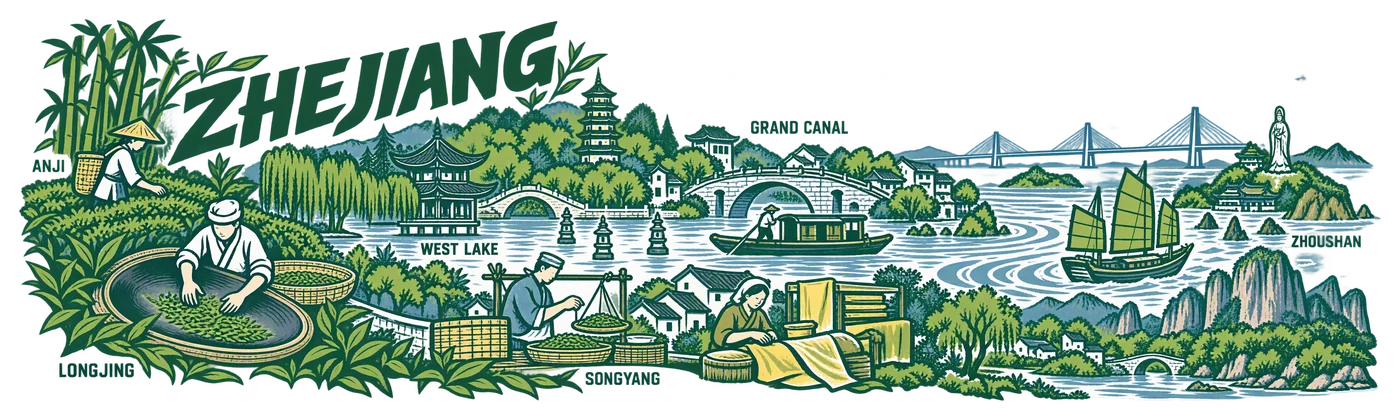
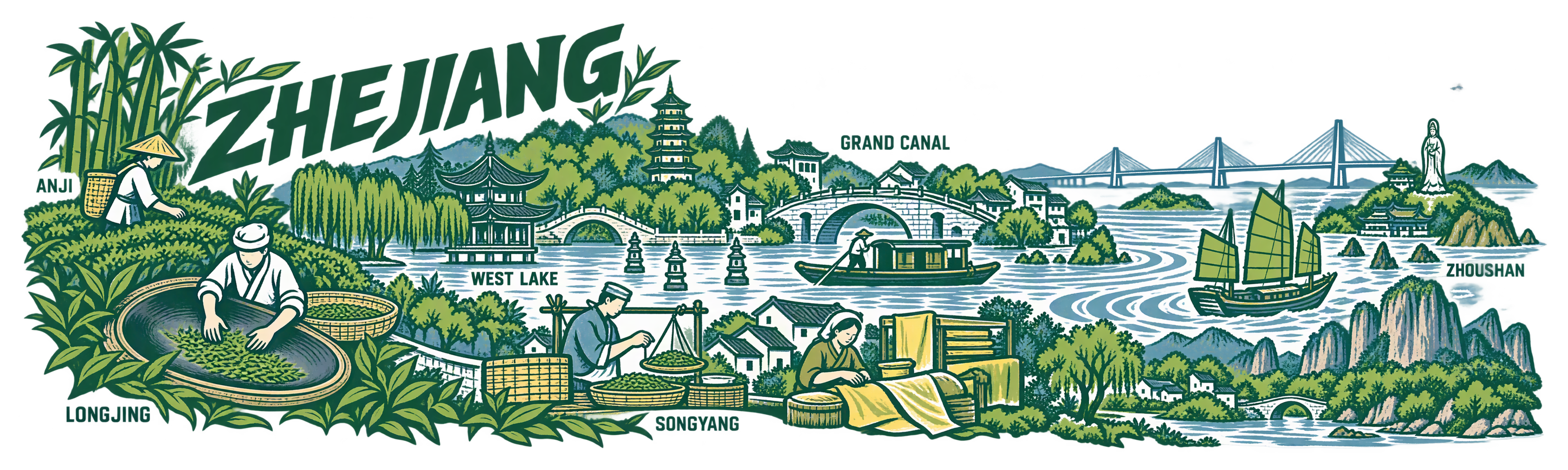
Clear dynamic ZHEJIANG with tea processing in front, Songyang market, lake, canal, and sea coast. Main captions are legible, cohesive composition without an external rectangular background.
PNG RGBA 3840 × 1152 px; real alpha channel; proportional export 250 × 75 mm.
Approved after review for the open gallery; does not imply the user's endorsement of industrial production.
Creative brief palette
#345C47
#688C9E
#9BA958
Original generation prompt
Text matches the public TXT. The list of inscriptions and details describes the author's brief; this is not OCR and not a promise of reproducibility without the references used.
SHA-256: 565dcc5c386ef181a338160fb39f0474c2971349874ef9f761d451f3d7ec5096
Read the full prompt
Create an original collectible regional ceramic PRINTING DECAL, not a mug or mockup. The supplied image is a drawing/style benchmark only: replace every reference-region subject and word with the researched region described below. Make a confident, rewarding composition whose tea craft, architecture and landscape belong together.
OUTPUT: PNG RGBA, native 3840 x 1280 px. Keep every mark inside x=60..3780 and y=110..1170; use nearly the whole long strip. The final export is 3840 x 1152 px for 250 x 75 mm. Do not shrink the entire design to a central 16:9 picture. Preserve normal object proportions and complete edge objects.
ALPHA: genuine transparent exterior and natural transparent openings inside the drawing. No white or cream rectangle, paper texture, sky wash, sea fill, provincial silhouette, checkerboard, aura, gradient or drop shadow. Unpainted architecture, water and negative openings reveal alpha. Colour belongs to actual drawn objects, never a vague backdrop. Do not reproduce any opaque field visible in the reference.
For C1–C6, create ONE connected varied panorama with two or three unequal anchors, overlapping near/middle/far scales and smaller discoveries. Connect through real terrain, streets, roofs, branches and human actions, not dotted diagram routes. No two-row sticker sheet, isolated equal scenes, caption boxes, repetitive generic gardens or an empty band under the title. Do not impose a percentage of blank space. C7 instead follows its explicit irregular album direction below.
English lettering only, exact spelling, dark clear capitals for allowed captions. One main regional title. No Chinese characters, logos, invented seals, pseudo-writing, promotional superlatives or health claims. A short legible caption is preferable to microscopic text. Respect the stated distinctions between growing tea, processing it, trading it and serving it. A full research inventory need not become a printed gazetteer.

COLLECTION: A SWEEPING REGIONAL JOURNEY. Follow GD03: energetic angular pen contours, bold slanted region lettering, selective directional hatching and three clear inks. Compose a shallow diagonal or S-shaped journey carried by a real regional movement motif. Bold near craft and people interlock with farther landmarks and terrain. Clean graphic edges, never watercolour, fuzzy labels or sticker scenes.
REGION: ZHEJIANG.
PALETTE: #345C47, #688C9E, #9BA958. Preserve this regional colour family; first colour supplies the strongest contour/text. Extra dark/light rendering colours and full-colour watercolour are not wanted.
RESEARCHED CONTENT:
Preserve the source map's varied Zhejiang: West Lake pavilion and pagoda, bamboo and low Anji tea terraces, Tianmu uplands, old Grand Canal arched bridge, Qiantang tidal-water contours, modern Hangzhou Bay bridge, coastal Ningbo/Zhoushan sails and islets, southern Yandang ridges, inland Lishui hills and the Ou River. Tea stays tangible through a large Longjing wok and hand-flattened leaves, pale Anji tea shoot, a Songyang tea-market scale, Pingyang yellowing cloth, a Jingshan tea-sharing table and a small Putuo island garden. A canal boat is transport, not a tea plantation. Different water passages are an editorial itinerary, not a single falsely connected canal. Avoid a skyline of generic pagodas; architecture comes from a small number of observed map motifs. The old stone bridge and long modern bay bridge must have different proportions.
AUTHORED COMPOSITION:
A shallow S motion starts with a tea picker stepping from Anji bamboo at upper left, curves around the close Longjing wok, passes under the old canal bridge, then opens into Qiantang water strokes and a right-hand sail. Jingshan roofs and West Lake pagoda occupy the inner arc; Songyang tea scale and Pingyang wrapping cloth sit along the nearest working bank. Put a compressed Yandang mountain silhouette behind the southern bank, without filling the sea or sky. The modern bay bridge is a fine distant horizontal counter-rhythm. Bold slanted ZHEJIANG follows the upper sweep, integrated with foliage and roof edges rather than isolated in a banner.
LETTERING PLAN:
ZHEJIANG once; six supporting captions maximum: LONGJING, ANJI, WEST LAKE, GRAND CANAL, SONGYANG, ZHOUSHAN.
REGIONAL SAFEGUARDS:
Anji Baicha is green tea, not the white-tea processing category. Longjing is flattened tea, not spherical pellets. Pingyang yellow tea has a wrapping/yellowing craft cue; do not colour every tea yellow. Oil-tea camellia is excluded. Keep northern lake/canal, southern Ou River and sea islands distinct. No invented heights, imperial stories, medical claims or unidentified monuments given precise names.
FINAL STANDARD: sharply drawn object edges, deliberate line hierarchy, vivid meaningful local differences and a recognisable whole place. Protect the main title and key silhouettes; never solve complexity by making everything equally tiny.