Heilongjiang / HL_C3
Heilongjiang — Tea territories
The path from the tea stall through the railway stop to forest tea drinking.
Checked for publication · Drawing review and technical check of the current file
Review basis
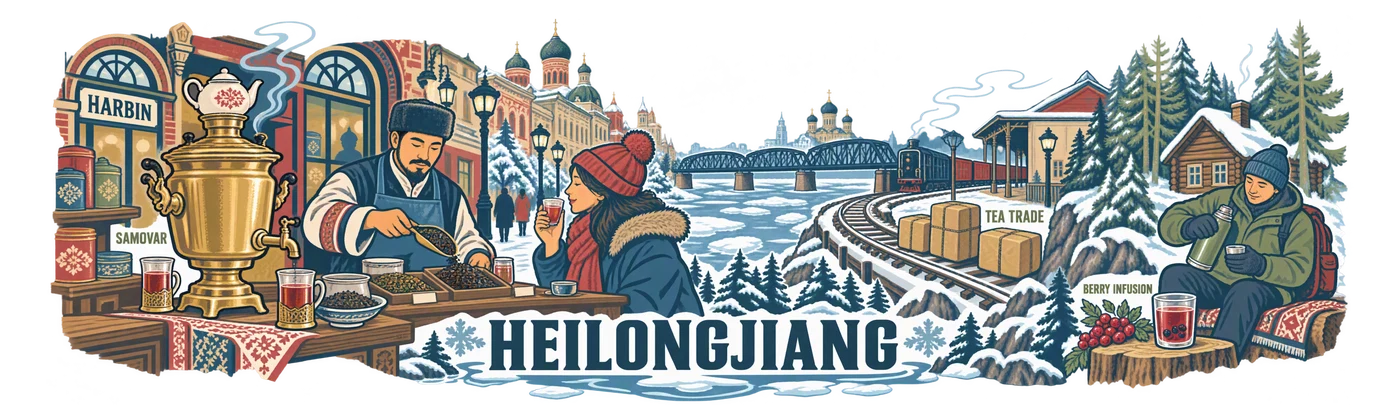
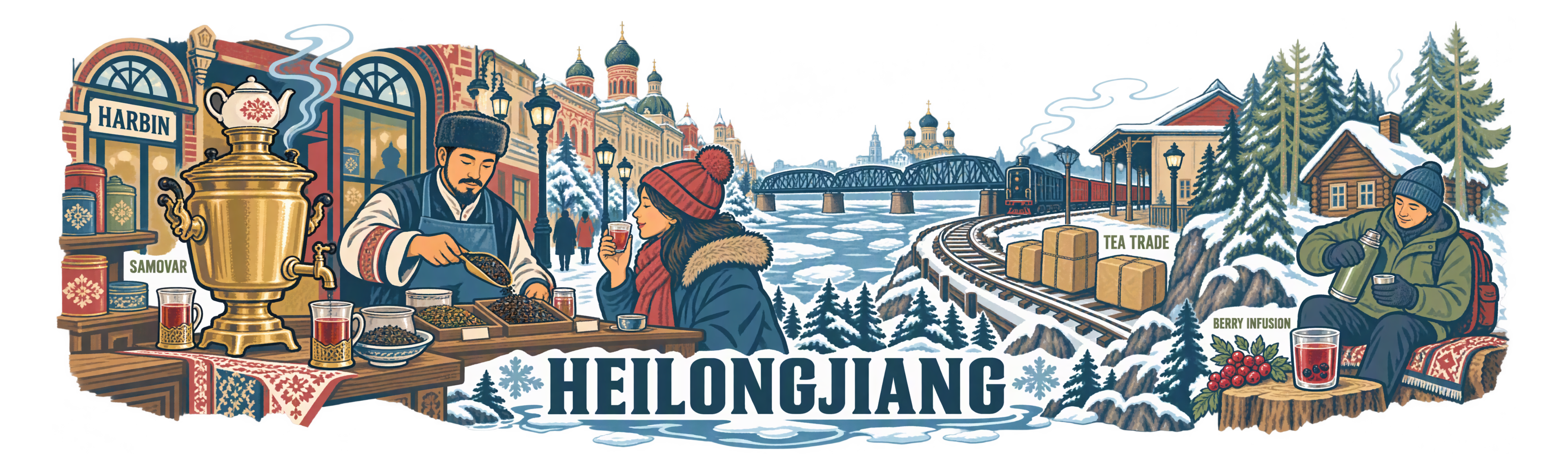
HEILONGJIANG intact; sharp coherent illustration with large tea trade, railway, and separate BERRY INFUSION. Labels legible, no invented local tea plantations. No common backing visible from outside; snow/water-filled objects are not declared as exact color separation.
PNG RGBA 3840 × 1152 px; real alpha channel; proportional export 250 × 75 mm.
Approved after review for the open gallery; does not imply the user's endorsement of industrial production.
Creative brief palette
#23465F
#BC4551
#6D99AF
#7E8C71
#C5A45B
Original generation prompt
Text matches the public TXT. The list of inscriptions and details describes the author's brief; this is not OCR and not a promise of reproducibility without the references used.
SHA-256: 0bd2e551ed0c0c32a2dd58cdcc7d422df9cff21267e208a67014b6ab7afec622
Read the full prompt
Create one exceptional, completely flat regional ceramic-print artwork. This is the actual printable illustration, never a cup, product photograph, mockup, presentation board or simulated ceramic surface. The collection reference controls drawing language only: invent a new composition for the specified region and replace all Guangdong-specific objects. The source map supplies a regional inventory, not a paper texture or a layout to trace literally.

TECHNICAL CONTRACT: native canvas exactly 3840 x 1280 pixels, true RGBA PNG. Keep every visible mark, letter, ornament and antialiased edge inside x=60..3780 and y=110..1170. The final delivery will use a centered 3840 x 1152 export for a 250 x 75 mm wrap; leave the native safety area completely transparent. Compose for a long horizontal physical print, not a conventional poster. Nothing is cut off at either end. All exterior space and meaningful holes between objects must have alpha zero. No painted background, white underpainting, sky rectangle, tinted paper, land silhouette, colour fog, opaque backdrop or checkerboard. The wearer-visible ceramic supplies the unprinted space. Use the specified colours as ink, with normal edge antialiasing; do not invent extra white, black or metallic ink. Never print dimensions, crop marks, palette swatches, filenames, reference names or instructions.

ART DIRECTION: create a memorable hierarchy, a major focal scene and a quieter counterweight; alternate large close forms with medium stories and a few small discoveries. Let tea life interact with the region. Connect selected objects through a real roofline, tabletop, lane, ridge or river contour; retain clear breathing channels so each gesture and vessel is legible. Do not impose any percentage of empty space. Avoid both a cramped rectangular carpet and timid isolated stickers. Use confident, intentional linework that will survive the 75 mm print height. Limit texture to useful material clues. Any water, snow, steam or clouds are sparse outlines with transparent interiors, never washed fills. No photographic gradients, glow, heavy grunge, blurred edges or tiny illegible hatch fields.

FACTUAL DISCIPLINE: the scenes below distinguish cultivation, processing, trade, hospitality and non-tea infusions. Do not turn imported tea, berries, ginseng, barley, trees or grasslands into tea plantations. Do not invent a local tea cultivar, a named historic tea shop, medical effects, a precise trade route or archaeological evidence. Landmarks are cultural/geographic motifs, not assertions that tea was grown or traded at their gates. A contemporary tea pause next to a landmark is an authored scene, not a documentary historical claim. Keep people natural and respectful, with plausible hands and gestures; use no decorative pseudo-script.


C3: LIVING TEA TERRITORIES. Make an oblique, connected illustrated tea world, held together by a locally meaningful river, street, mountain fold or caravan corridor. Large foreground hospitality or craft overlaps medium buildings and small distant geography. Five flat inks, expressive editorial drawing and carefully observed vessels. No administrative outline, amusement-park badge grid or generic ornamental tea leaves. Integrate a strong condensed regional heading in the lower rhythm, not in a separate title band.

REGION: Heilongjiang. Exact ink palette: #23465F, #BC4551, #6D99AF, #7E8C71, #C5A45B. The first colour supplies the main line; the others have deliberate separate roles, not gradients.

AUTHENTIC SUBJECT MATTER:
The region is a northern meeting place for tea consumption and trade, not an invented tea-growing province. Use a large samovar with its small brewing teapot, a tap, and two plain glass tea cups as a visual cultural motif from the regional map; do not name a museum or claim a particular historic origin. Beside a Harbin-style arched shop window, a present-day tea seller weighs imported loose leaf from a plain tin into a shallow scoop; a customer samples it at a modest tasting tray. On the quieter side, a gloved traveller opens a tea thermos beside a small timber cabin and a few larches: this is an authored contemporary tea pause. A short railway curve and two unlabelled tea parcels express transport without asserting a precise ancient tea route. Separately show a small forest-berry infusion in a glass with a berry twig; the berries are a non-tea ingredient, never tea plants or a medicinal formula. Keep real tea vessels and human service gestures larger than winter architecture. No fur barter, shamanic ceremony, rhododendron recipe or snowy tea plantation.

SPECIFIC COMPOSITION:
Make an imagined tea street that bends into a riverbank and finally a forest rest stop. The middle foreground is a tea seller extending a measured scoop over a broad tasting tray. The large samovar belongs to the left shop interior, with a real visible tap and brewing pot. A cabin, thermos and seated traveller form the right counterweight. Tea parcels sit by a small rail platform connecting both worlds; the berry infusion occupies a separate small shelf. Only two distant roof and larch silhouettes establish the cold setting. Integrate the title low along the riverside opening, and keep hands and hot vessels warm in scale rather than buried under snow scenery.

VISIBLE TYPE: exact main title "HEILONGJIANG" once. Use only these optional small English labels, integrated beside the appropriate scenes and large enough to read: HARBIN, TEA TRADE, SAMOVAR, BERRY INFUSION. Do not add other text. No Chinese characters, bilingual captions, pseudo-calligraphy, gibberish, slogans, logos or signatures. Prioritize visual storytelling over words. Do not allow letters to merge with foliage or buildings. The design must feel like a collectible regional artwork that a tea professional would want to handle and study.