Fujian / FJ_C2
Fujian — Six Letters, Many Tea Worlds
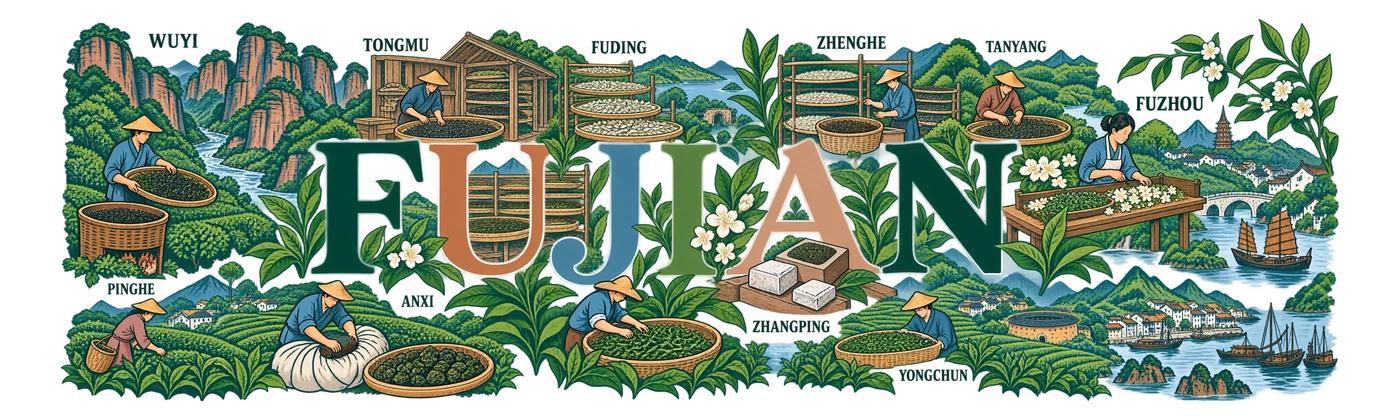
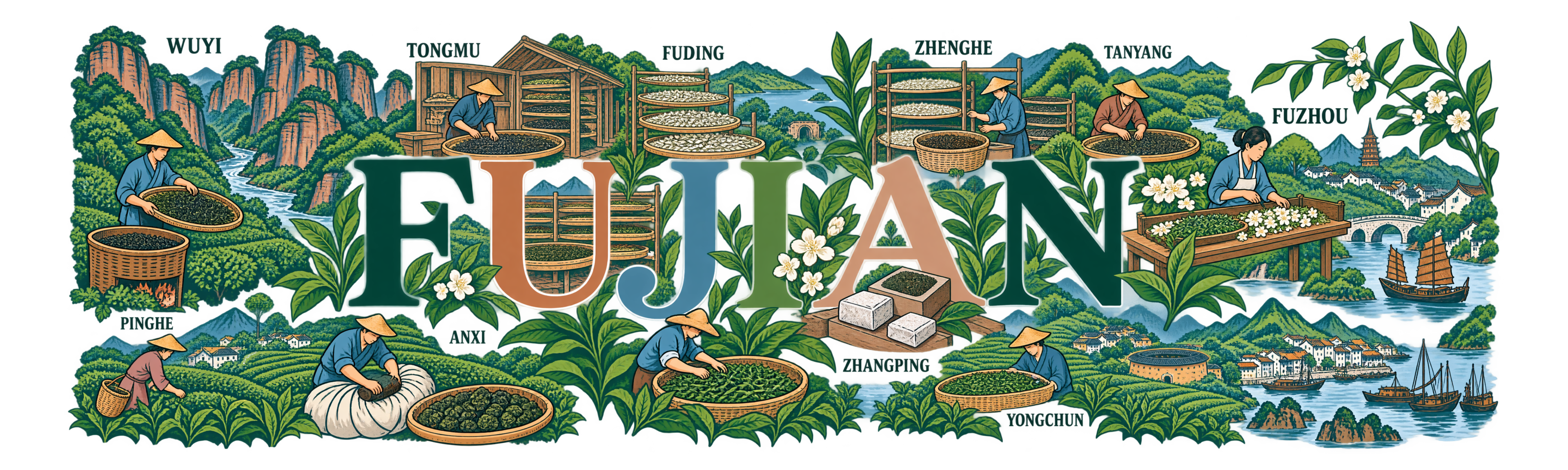
The word FUJIAN becomes the architecture of the drawing: rocks support F, shelves enter U, jasmine twines around the edge of I, and the pressing of square tea closes the right side.
Checked for publication · Drawing review and technical check of the current file
Review basis
The corrected FUJIAN is legible; clean colored letters interact with roasting, white-tea trays, jasmine, and the square format. The previous muddy texture is removed; captions are readable.
PNG RGBA 3840 × 1152 px; real alpha channel; proportional export 250 × 75 mm.
Approved after review for the open gallery; does not imply the user's endorsement of industrial production.
Creative brief palette
#245D58
#AB653D
#829C49
#C89983
#608BA5
Original generation prompt
Text matches the public TXT. The list of inscriptions and details describes the author's brief; this is not OCR and not a promise of reproducibility without the references used.
SHA-256: 0b924f389b280b15a19d606a6458ec1977735fdf2eedfbb24d3701fd57cb609c
Read the full prompt
PRODUCTION REVISION: Use crisp deliberate print strokes and bounded flat colours, not a textured low-resolution painting. No fuzzy contour, photographic shading, painterly haze or opaque landscape panel. All exterior and interior empty space is transparent alpha zero. Keep all letterforms and complete objects inside x100..3740 and y120..1160 on the native canvas. Render the main region title clearly; if a tiny caption would be unreadable, omit that caption rather than duplicate or distort it. The white surface in the reference is a viewing aid and must not be drawn.

Create an original collectible regional ceramic PRINTING DECAL, not a mug or mockup. The supplied image is a drawing/style benchmark only: replace every reference-region subject and word with the researched region described below. Make a confident, rewarding composition whose tea craft, architecture and landscape belong together.
OUTPUT: PNG RGBA, native 3840 x 1280 px. Keep every mark inside x=60..3780 and y=110..1170; use nearly the whole long strip. The final export is 3840 x 1152 px for 250 x 75 mm. Do not shrink the entire design to a central 16:9 picture. Preserve normal object proportions and complete edge objects.
ALPHA: genuine transparent exterior and natural transparent openings inside the drawing. No white or cream rectangle, paper texture, sky wash, sea fill, provincial silhouette, checkerboard, aura, gradient or drop shadow. Unpainted architecture, water and negative openings reveal alpha. Colour belongs to actual drawn objects, never a vague backdrop. Do not reproduce any opaque field visible in the reference.
For C1–C6, create ONE connected varied panorama with two or three unequal anchors, overlapping near/middle/far scales and smaller discoveries. Connect through real terrain, streets, roofs, branches and human actions, not dotted diagram routes. No two-row sticker sheet, isolated equal scenes, caption boxes, repetitive generic gardens or an empty band under the title. Do not impose a percentage of blank space. C7 instead follows its explicit irregular album direction below.
English lettering only, exact spelling, dark clear capitals for allowed captions. One main regional title. No Chinese characters, logos, invented seals, pseudo-writing, promotional superlatives or health claims. A short legible caption is preferable to microscopic text. Respect the stated distinctions between growing tea, processing it, trading it and serving it. A full research inventory need not become a printed gazetteer.

COLLECTION: A LIVING REGIONAL WORD. Follow the supplied GD22 reference: a monumental original serif region name interlocks with illustrated tea life. Make each letter instantly legible. Roofs tuck under terminals, branches overlap selected edges, people work at letter bases, and regional landforms flow between counters. Crisp decorative pen illustration and selective five-colour accents, never a painting pasted inside letters.
REGION: FUJIAN.
PALETTE: #245D58, #AB653D, #829C49, #C89983, #608BA5. Preserve this regional colour family; first colour supplies the strongest contour/text. Extra dark/light rendering colours and full-colour watercolour are not wanted.
RESEARCHED CONTENT:
Fujian is a major tea-growing and tea-making province, with distinct northern, eastern and southern traditions. Build varied real processes rather than identical green gardens. NORTHWEST: Wuyishan rock oolong among tall eroded cliffs, a maker shaking a bamboo tray, long twisted leaves and a charcoal-roasting basket; Tongmu black tea appears as a modest timber processing room and long dark leaves, not another rock-oolong clone. NORTHEAST: Fuding white tea has open withering trays with plump buds and leaves; neighbouring Bailin has a separate little black-tea sorting tray. Zhenghe has white-tea withering racks plus a small distinct dark-leaf basket for its gongfu black tea. Fu'an/Tanyang shows a hand sorting slender black leaves. EAST: Fuzhou is a scenting worktable with open jasmine flowers beside green tea, not flowers growing on tea bushes. SOUTH: Anxi Tieguanyin has a cloth-wrapped rolling bundle and tightly rolled oolong; Yongchun Foshou has a broad natural tea leaf and basket; Zhangping Shuixian has a wooden square mould and small square paper-wrapped cakes; Pinghe Baiya Qilan and Zhao'an Baxian occupy different little lower-slope branches of the southern garden with tea shoots and a picking basket. CENTRAL/WEST: Datian Beauty tea appears as a small hand-sorting activity, Wuping green tea as a shallow pan and fine green leaves. These secondary scenes share actual work surfaces, slopes and roofs. Min River links northern slopes with the Fuzhou story; the southern Jiulong drainage is a separate lower rhythm, not a claim all places stand on one river.
AUTHORED COMPOSITION:
FUJIAN is the hero, spanning the middle of the strip in beautifully drawn large serif letters. A Wuyi cliff shoulder rises through the open space beside F; the U cradles northern withering racks without losing its counter. A low jasmine worktable and flowering branch touch the I base. The J descender curves toward an Anxi rolling cloth, and the broad lower foot of A shelters the Zhangping mould. The N's right foot meets a tiny harbour roof. Never literally turn the letter into a mountain or fill every counter. Place crisp human tea work both in front of selected letter edges and behind their upper shoulders. Small black-tea sorting and southern tea shoots enrich the inter-letter passages. Diagonal leaf rhythms oppose the horizontal word, giving an alert editorial energy. The result is a living designed word with precise pen detail and five controlled accents, not a giant naked title or a generic green landscape painted inside it.
LETTERING PLAN:
FUJIAN is the only large title. Ten secondary clean small capitals: WUYI, TONGMU, FUDING, ZHENGHE, TANYANG, FUZHOU, ANXI, ZHANGPING, YONGCHUN, PINGHE. Make them short, dark and readable; no product slogans or additional microtext.
REGIONAL SAFEGUARDS:
Tea forms must differ: long rock-tea strips, white buds/leaves, rolled Anxi oolong and square Zhangping cakes. Jasmine is added during scenting of actual tea, not a medicinal herbal drink. Foshou is a tea name, not sliced Buddha's-hand citrus; Shuixian is not a narcissus-flower infusion. Keep Min and Jiulong as editorial river rhythms rather than one false hydrological channel. No mainland-wide landmark collage, no pagodas duplicated at every cluster, no exact-date or healing claims.
FINAL STANDARD: sharply drawn object edges, deliberate line hierarchy, vivid meaningful local differences and a recognisable whole place. Protect the main title and key silhouettes; never solve complexity by making everything equally tiny.