Kawasaki / v37
Kawasaki
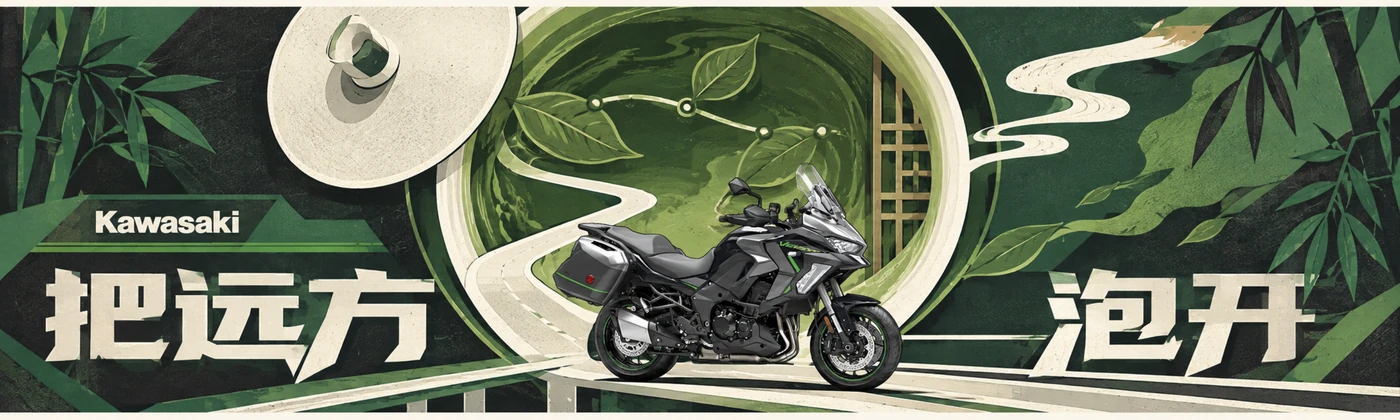
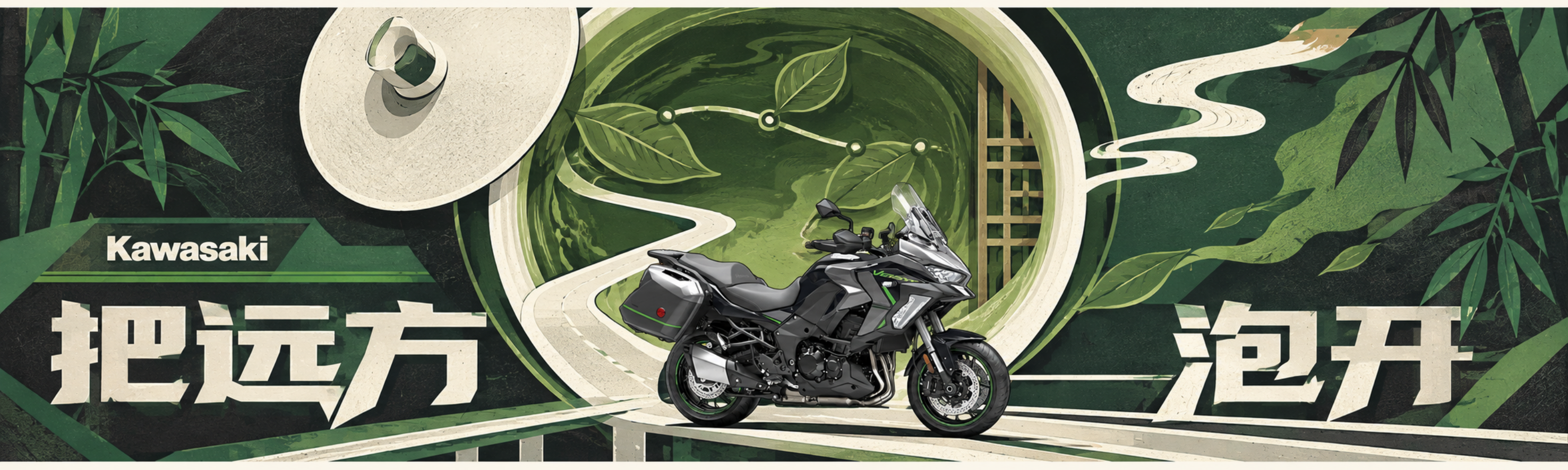
Центр афиши — огромный круг чайного настоя, прочитанный одновременно как верхний вид гайвани и условная экспедиционная схема. Снятая крышка становится смещённым диском; из разрыва окружности выходит жёсткая лента дороги. Реальный серый Versys с кофром пересекает её снизу по центру. Несколько чайных листьев обозначают этапы пути без цифр и подписей. Китай появляется в геометрии гайвани и бамбуковой решётки чайного подноса, а не в фоновой панораме.
Проверено для публикации · Документированный визуальный QA канонического финала
Графический язык
Геометрическая экспедиционная афиша: плоская шелкография, крупные зелёные и графитовые формы, строгие окружности и трапеции, серебристые выворотки; без манги и пейзажной живописи.
Китайская фраза в задании
把远方泡开
Перевод
Завари чай — и раскрой дальние дали.
Мотоцикл в референсе
Туристический Kawasaki семейства Versys: серо-графитовый высокий кроссовер с зелёными акцентами, высоким прозрачным ветровиком, угловатым передним обтекателем и жёстким боковым кофром. На фото читается Versys. По форме и видимым выпускным трубам похож на крупный Versys 1000/1100, но точный объём, год и индекс комплектации по этому кадру не фиксируются.
Уверенность в определении модели
Высокая для семейства Kawasaki Versys и наблюдаемого оснащения; средняя для семейства 1000/1100; точные год, объём и комплектация не установлены. Изображение пользователя приоритетнее текущих каталогов.
Сохранённые признаки модели — авторское задание
Сохранить ракурс фотографии: мотоцикл обращён вправо, передняя часть видна в три четверти; высокий туристический силуэт, не Ninja и не низкий спортбайк.
Основные панели серые, серебристые и графитовые; зелёные только небольшие вставки, линии и тонкие полосы ободов. Не перекрашивать весь мотоцикл в зелёный.
Высокий прозрачный ветровик, высокие зеркала, широкое рулевое оснащение/защита рук, угловатый объёмный передний обтекатель с вытянутой боковой световой секцией.
Чёрное ступенчатое двухместное седло; крупный видимый жёсткий боковой кофр с серебристой верхней частью, зелёной линией и круглым красным отражателем.
Литые тёмные колёса с тонкими зелёными ободами и дорожными шинами; сохранить дисковые тормоза и полные окружности обоих колёс.
Серебристый выхлоп, тёмный двигатель, видимые изогнутые металлические выпускные трубы. Задняя площадка остаётся без выдуманного верхнего кофра.
Основание проверки
Просмотрены все девять мастеров и девять конечных печатных PNG.
Индивидуальная проверка модели/текста/кадрирования; существенных блокирующих дефектов финального экспорта не отмечено.
Допуск опирается на сохранённую визуальную проверку финального print-файла, не на факт API completed. Микротекст, точность векторных логотипов и цветопроба не сертифицируются.
Сохранённые открытые источники
Точное текстовое задание
Текст совпадает с публичным TXT. Перечень надписей и деталей описывает авторское задание; это не OCR и не обещание воспроизводимости без использованных референсов.
SHA-256: 558f9e1092af58af7ce614d9fb4c8743601eb29455568d93bbed56517c42f7f4
Прочитать полный промпт
Use case: stylized-concept.
Deliverable: one new standalone panoramic collectible print joining Chinese tea ritual with this exact motorcycle. Flat finished artwork, viewed straight-on. No mug mockup, packaging mockup, photographed print, wall display or presentation board. A teapot, tea bowl or gaiwan drawn inside the art is part of the story.
Reference hierarchy: IMAGE 1 is the user's exact motorcycle subject. Preserve its recognisable model geometry, paint scheme, wheel type, fairing, windscreen, exhaust and visible luggage configuration. Re-illustrate it in the chosen medium, rather than replacing it with a generic bike from this brand. Any second image is ONLY the existing brand logo reference; it must not influence the motorcycle model or composition. Photo backgrounds are not part of the design.
Canvas: an extremely wide 3:1 high-resolution image, ideally 3840 × 1280 or the highest native wide detail available. The final print will be 250 × 75 mm (10:3), prepared by proportional placement and a small crop of outer blank bands. Leave plain opaque white bands across the outermost 6% at the top and bottom. Compose the complete artwork in the central 88% height. Keep EVERY letter, badge, motorcycle wheel, mirror and windshield, and all important tea-vessel contours, safely within the central 78% height and 4% inward from left/right edges. Never stretch the motorcycle. High quality printable detail, strong large shapes and beautiful hierarchy at 75 mm physical height.
Typography: the exact Chinese phrase specified below is the sole narrative text. Original Latin brand/model lettering may remain as identity. No English/Russian slogans, faux captions, dimension labels, dates, random numbers, decorative pseudo-Chinese seals or watermarks. Chinese strokes must be accurate, complete and confidently readable.
Quality: a genuinely new art direction and composition, coherent craft across the whole scene, conceptually integrated tea and machine. Avoid a generic motorcycle photograph pasted in front of mountains. Chinese visual culture only; no generic mixed-Asian motifs.


Brand: Kawasaki. Exact narrative text: 「把远方泡开」.

Use the supplied Kawasaki photograph as the authority for the motorcycle's silhouette, perspective, paint and installed equipment. Create a forceful geometric expedition poster, built as a disciplined flat screenprint in charcoal, graphite, deep forest green, vivid tea green and warm ivory. The dominant green belongs to the surrounding graphic world: the motorcycle itself must remain the silver-gray and dark-graphite touring Versys from the photograph, with only its actual small green accents. Do not turn it into a green Ninja or an off-road dirt bike.

Organize the picture around a huge, slightly off-center circular tea infusion seen from above. This is both the bowl of a Chinese gaiwan and an abstract expedition diagram. Its lid is a separate offset ivory disk, with a unmistakable small lid knob, positioned above and to the left like a displaced eclipse. A precise wedge opens in the main circle. From that opening, one broad angular road folds downward and then horizontally across the lower middle of the composition. The reference motorcycle travels across this geometric bridge, occupying the central lower register, its complete front and rear wheels visible. This must feel like distance being opened by brewing tea, rather than a vehicle parked beside a cup.

Draw the motorcycle with hard, economical planes and carefully chosen silver highlights. Keep the tall transparent windscreen, upright cockpit, mirrors, protective hand controls, stepped black saddle, angular touring nose and slim vertical side-light shape. Preserve the prominent rigid side pannier, including its silver upper section, narrow green stripe and small round red reflector. Keep the dark cast wheels, road tires and thin green rim stripes. Preserve the substantial engine, curved metallic exhaust headers and silver exhaust. The rear carrier remains free of an invented top box. Mechanical details can be simplified into accurate blocks, but wheelbase, fairing mass, luggage silhouette and rider position must stay faithful to the photograph.

Inside the tea disk, three oversized tea leaves become abstract waypoints, connected by a clean angular line without numbers or labels. A small section of Chinese bamboo tea-tray lattice appears as a graphic grating at the opposite edge, echoing a bridge structure. Do not add a mountain horizon, a landscape panorama, an illustrated rider or expedition equipment absent from the photograph.

Set the exact Chinese headline 把远方泡开 as the principal typographic anchor below the circular system, split deliberately into 把远方 and 泡开 with strong visual reading order. Use confident geometric Chinese display lettering, not manga brush strokes. Integrate the authentic Kawasaki wordmark discreetly into a dark structural block. Make the overall rhythm circular at the center and angular at the edges, with crisp ink overlaps, restrained paper grain and large purposeful negative spaces.